
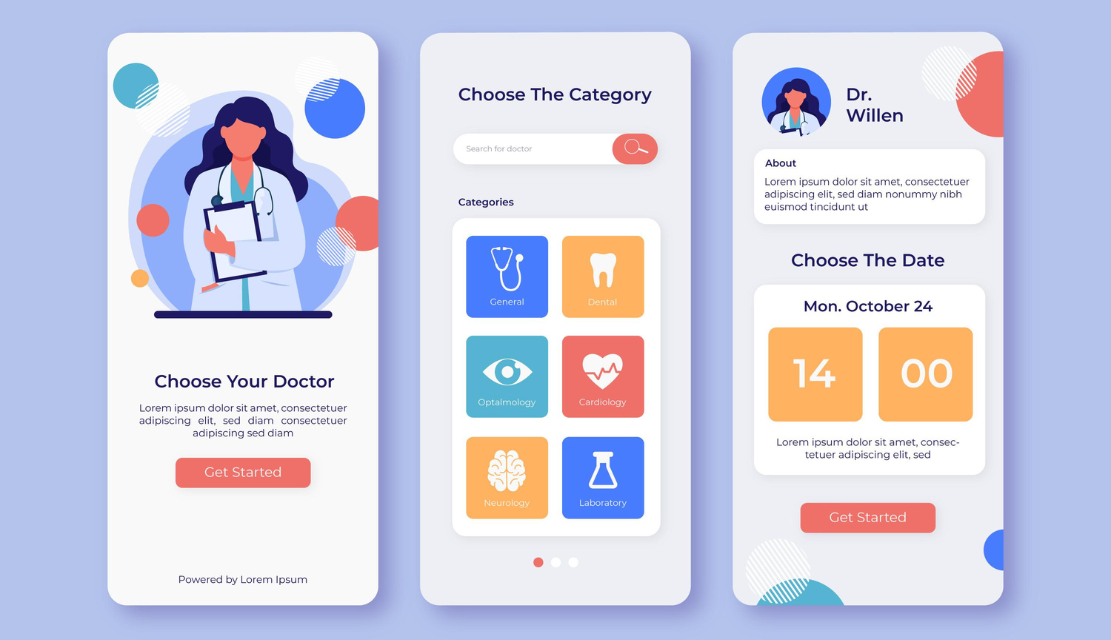
Your healthcare platform invested a lot of money in technology. Secure portals for patients to access their health, tele-health capabilities, online scheduling. Yet part of the patients desert the experience because it is poorly usable. You’re losing out on qualified patients before they ever book out. The problem ends not with your clinical expertise or technology infrastructure – it ends with the digital experience. Patients make their assessments of healthcare providers in less than three seconds, determining whether your platform is trustworthy, competent and easy to use.
One form that confuses one error message that is vague or a clunky interface and you destroy confidence in an instant. Healthcare UX design works under some pressure that is unique and specific to the area: mistakes don’t just annoy users – they affect people’s lives, they delay care and they cause medical errors, which may even harm patients. With as little as 39.9% of marketing-sourced leads actually booking appointments and 59% of qualified callers never converting, it is fair to say most healthcare providers lose patients as a result of preventable design failures rather than clinical shortcomings.
Healthcare UX is not cosmetic; it directly influences patient acquisition, retention and revenue. The statistics show huge opportunities.
Online appointment booking shot up from only 2.4% in 2015 to 32% in 2020, but even with that, most healthcare platforms are still struggling with basic digital experiences. Telehealth usage exploded 38x since the pandemic, and there is now an urgent need for seamless virtual care interfaces. Patients who are exposed to friction simply choose competitors – 73% would switch providers for a better user experience.
The monetary impact is even bigger than lost appointments. Patient lifetime values are between $10,000-20,000, while acquisition costs average $162-286 per lead. Every patient that we lose because of poor UX is a lot of revenue left on the table. Conversely, dropping the number of appointment form fields from 11 to 4 boosts conversions by 120%, showing how minor changes yield massive rewards.
Healthcare providers are not without their problems either. Up to 25% of patient calls are not answered at all. Among calls made to connect, staff conversion rates range 60% between people, so there is a training gap, not people not wanting to call. Well-designed digital experiences relieve this burden while enhancing outcomes.
Healthcare decisions carry emotional weight not experienced by patients in other industries. Unlike purchasing products online, medical appointment booking entails vulnerability, fear and uncertainty. Effective healthcare UX helps to address these psychological needs directly.
The basis is perceived competence. Patients judge their provider’s level of expertise on visual cues before they even read his or her credentials. Clean, consistent interfaces are professional and signify attention to detail. Outdated designs, broken links or slow loading pages are the immediate source of suspicion regarding clinical capabilities. Research shows that interfaces with structured layouts have significantly higher scores on perceived trustworthiness.
Patients require reassurance as they go along. In booking appointments, they are concerned about selecting the correct specialist, describing their symptoms, and the costs. Design helps to reduce anxiety by supplying context at decision points. Instead of “Book Appointment” buttons, use benefit-driven language: “Schedule your consultation” or “Get expert care.”
Transparency helps to develop confidence. Patients drop out of forms when they encounter unexpected requirements or sudden hidden information. Have all of the required steps up front: “3 easy steps to schedule your visit.” Display estimated appointment availability before patients put time into forms. Explain why you need information before asking for it: “We need your insurance information to check your coverage before your visit.”
Error recovery is of tremendous importance. When patients make mistakes in completing forms, the message of punishment increases the stress. Replace “Invalid input” with helpful information: “Please enter your birthdate in MM/DD/YYYY format.” Allow easy corrections, no loss of progress
Patient journeys have many places where people abandon the process. Identifying and removing these obstacles is the driving force in improving conversions.
Simplify appointment scheduling ruthlessly. Each additional form field cuts into completion rates. Successful healthcare platforms keep the required information to a minimum: 12-14 fields as opposed to industry averages of more than 20. Provide guest booking options or single sign-on options. Implement autofill towards returning patients through secure identifiers linked to EHR systems.
Mobile optimization is not an option. While mobile generated 7X more traffic than desktop, desktop still converted 22% better – revealing massive mobile optimization gaps. With 92.3% of internet users accessing healthcare information through mobile phones, bad mobile experiences eliminate most potential patients. Make forms work perfectly on small screens with large tap targets and simplified layouts
Provide more than one channel of contact. Patients have preferences – some prefer to be called on the phone, while others prefer to use online forms – many are using chatbots. Phone calls still convert 25-40% of the time compared with online forms, which explains why 88% of appointments are still scheduled by phone. However, providing online options is a way of capturing patients who won’t be able to call during business hours.
Seamlessly consolidate systems. Nothing annoys patients more than having to repeat information on disconnected systems. When scheduling platforms are integrated with practice management software, appointments are automatically integrated into provider calendars, and there is no need to manually input the appointment. This helps to avoid double-booking while also saving staff time and ensuring better patient experiences.
Use clear calls-to-action in the journey. Vague buttons such as “Submit” don’t communicate value. Specific, action-oriented CTAs do better: “Confirm my appointment,” “Talk to a specialist,” or “Get care today.”
HIPAA, ADA, GDPR and FDA regulations provide necessary guardrails to protect patient privacy and safety. Poor implementations view compliance as obstacles. Smart healthcare UX brings requirements to nature.
Frame data collection in terms of patient benefit, not legal need. When asking for sensitive information, use a value-first approach: “We protect your privacy with bank-level encryption” followed by the request. This makes security a feature, not a burden.
Use progressive disclosure for consent forms and privacy policies. Don’t overload patients at the outset with reams of legal text. Provide summaries with “Learn more” options for those who want details. Make privacy controls granular. Give patients control of what information they share.
Make accessibility accessible from the start: ensure that accessibility is WCAG compliant. This isn’t only about compliance, it’s about building your patient base. Knight and Hiedrich note: “Implement scalable text, high-contrast colour schemes, keyboard navigation, and screen reader compatibility.” These features are beneficial to all people, not just users with disabilities.
Design secure authentication that is protective and not paranoid. Biometric login with fingerprints or face recognition offers a better security level than passwords while greatly reducing friction. Actions are completed more quickly by patients, creating momentum for conversion.
Track metrics which show how design affects patient acquisition and retention. Monitor appointment booking completion rates on a step-by-step basis. Identify where patients fall off and why top practices have 70%+ completion rates compared to industry averages of close to 40%.
Measure time-to-first-appointment. How fast are patients progressing from initial visit to website to scheduled care? Faster activation is an indication of better trust and usability. Less than five minutes for straightforward appointments. Analyse the performance of the channels. Organic search has the highest prospect-to-patient conversion rate at 76.9%, which is far higher than other marketing channels. Email campaigns produce close to twice as many conversion rates as paid search and social. Understanding which channels are most effective in the process of conversion informs marketing investment.
Track no-show rates and rescheduling. High cancellation rates can be an indicator of scheduling friction, lack of communication, or uncertainty on the part of the patient. Well-designed systems of confirmation with reminders by text (98% open rate) reduce no-shows significantly.
Calculate patient lifetime value in relation to acquisition cost. Better UX will help to decrease the cost of acquiring and increase the retention of patients, which will improve the overall economics of the practice.
Healthcare UX in 2026 is all about predictive and personalised experiences. AI-controlled interfaces are used to analyse the patient’s history and behaviour and provide proactive recommendations. Instead of patients having to find symptoms, systems recommend relevant specialists based on cues.
Voice interfaces allow for hands-free scheduling appointments, medication reminders and vital sign checks. Patients ask, “When’s my next appointment?” and get instant replies, which makes healthcare management conversational instead of transactional. Wearables and IoMT devices provide real-time data to platforms for remote patient monitoring. Clinicians intervene early on when there are indications of trouble, and maintain closer relationships by staying in touch on a continuous basis instead of visiting episodically.
Ambient intelligence is an approach of using unobtrusive sensors to detect falls or health deviations without the need for tangible interactions. Entire environments become device-agnostic sensors, sending the alerts only when needed – reducing notification fatigue.
Telehealth develops into hybrid care pathways. Patients begin with checkers for symptoms, progress up the ladder to video consultations, then to in-clinic visits in unified settings. The distinction between virtual and physical care vanishes.
Use progressive disclosure–gather important information first and then gather other details when interacting with them later on. Link forms to EHR systems to bring back patients to pre-fill known data.
Provide credentials prominently displayed, security badges near forms, pricing clarity, patient testimonials and real-time availability for patient appointments are all examples of measurable improvements in conversion.
Both. Phone calls still convert 12-20x better than forms, but online booking captures patients that won’t call. Provide different channels and optimise for each channel.
Continuously A/B test variations, but never sacrifice HIPAA compliance and patient safety to test. Just focus on form design, CTAs, and content clarity.
Forcing patients to repeat information from system to system. Disconnected platforms with redundant data entry destroy trust and waste patient time.
Measure completion rates, time-to-appointment, channel conversion, no-show rates, and patient satisfaction scores. Compare pre- and post-performance changes.
Discover how UX Stalwarts helped 1,250+ clients to create healthcare platforms that patients actually trust and use. Identify friction points that are costing you appointments and revenue.
Partner with UX Stalwarts today to design patient-centric experiences to convert leads into long-term partners.

C – 81C, Sector – 8, Noida 201301, India


1025 Beamon Drive, Franklin 37064 Tennessee, USA
Sveavagen 34 111 34 Stockholm, Sweden
A-10, Sahastradhara Rd, Doon IT Park, Dehradun, Uttarakhand

© 2026 UX STALWARTS. All rights reserved.

