Building a digital product without dedicated product design ownership is like constructing a building without an architect. Features get shipped, but the experience feels disconnected. User flows conflict with business objectives. Engineering teams build what was specified, yet adoption stalls because nobody designed the product holistically. This gap costs organizations more than they realize, not only in wasted development cycles but in user trust, competitive positioning, and time-to-market. For companies building SaaS platforms, consumer applications, or enterprise tools, product design is the connective layer between what users need, what the business requires, and what engineering can deliver.
Our digital product design services place experienced product designers inside your team to lead the full design lifecycle. From early concept exploration and competitive landscape analysis through user research, information architecture, interaction prototyping, visual refinement, and developer handoff, our designers operate as cross-functional owners, not isolated contributors. Whether you need to hire product designers for a new product launch, an existing platform transformation, or a focused feature sprint, our team delivers outcomes rooted in strategic thinking and user evidence. Every engagement produces a product design that balances user desirability, business viability, and technical feasibility from the outset.
With eighteen years of cross-industry experience, our product design teams have partnered with startups validating first concepts and enterprises redesigning complex digital ecosystems. This operational depth means faster strategic alignment, stronger cross-functional collaboration habits, and design decisions that account for downstream engineering and business realities. Unlike talent marketplaces that match profiles to job descriptions, we provide product design agency expertise where designers arrive with methodology, domain context, and the ability to lead rather than follow. When you hire a product designer from our team, you gain full-lifecycle product ownership backed by proven process and measurable delivery standards.

Our product designers own every phase from early discovery through post-launch optimization. They do not hand off responsibility at wireframes or stop at visual polish. This end-to-end ownership ensures continuity across research, strategy, design, and iteration, eliminating the fragmentation that occurs when different specialists handle disconnected stages of the product development process.

Product design succeeds when it connects business goals, user needs, and engineering constraints. Our designers work directly with product managers, engineers, and stakeholders to align priorities and resolve trade-offs collaboratively. This embedded collaboration model prevents the siloed decision-making that leads to features users ignore and rework that delays releases.

Our designers have shipped products across healthcare, fintech, ecommerce, real estate, education, and enterprise SaaS. This domain breadth means they bring validated interaction patterns, flow structures, and usability benchmarks from relevant sectors into your engagement, reducing the trial-and-error that costs time when designers lack industry-specific context and familiarity.

We ground every product design decision in user evidence. Our teams conduct user interviews, task analysis, and usability testing throughout the design process, not just at the beginning. This continuous validation discipline ensures that what gets built reflects how users actually behave rather than how internal teams assume they behave.

Whether you need to hire digital product designers for a twelve-month embedded partnership or a concentrated four-week concept sprint, we structure engagements around your product stage and team capacity. Scale design resources without recruitment delays, onboarding friction, or long-term contractual commitments that lock your operational flexibility.

Every deliverable from our team is engineered for implementation clarity. Annotated prototypes, interaction specifications, component rationale, and responsive behavior documentation accompany design files. Engineering teams receive context alongside assets, reducing interpretation gaps and the costly back-and-forth cycles that silently inflate timelines when design intent is not clearly communicated.
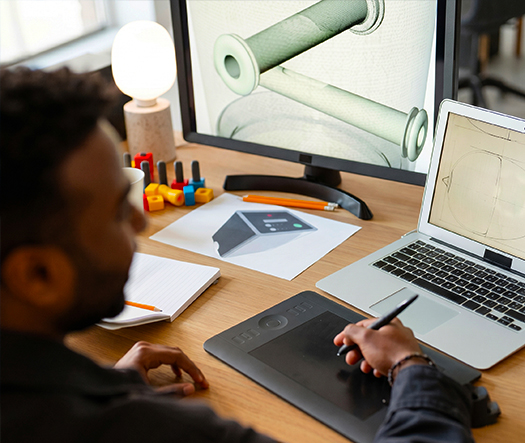
The difference between a product that users tolerate and one they advocate for often comes down to design ownership. When a skilled product designer leads the experience, onboarding completion rates improve because first-use flows are intentional. Feature adoption increases because capabilities are discoverable, not buried. Support costs decrease because self-service paths are intuitive. These outcomes translate directly into revenue retention, lower acquisition costs, and faster growth. Our team brings the discipline of structured product design and development services to every engagement, combining strategic thinking with execution precision to create products where every interaction is purposeful, efficient, and aligned with business performance goals.
Bring product designers who own the outcome, not tasks.
Every product design engagement follows a structured, milestone-driven approach that connects strategic intent to shipped outcomes with clarity.

We open every engagement by aligning on product vision, business objectives, user segments, competitive landscape, and technical constraints through structured workshops and stakeholder interviews. This phase is critical because misaligned teams produce fragmented products. The deliverable is a product design brief that defines goals, success metrics, and scope boundaries for all subsequent work.

Our designers conduct user research, competitive analysis, and opportunity mapping to understand the problem space before proposing solutions. We interview users, review behavioral data, and analyze market positioning to identify where experience gaps create the greatest risk or opportunity. The output is a research synthesis with prioritized design opportunities linked to business value.

Using exploration findings, we define the product experience through journey frameworks, information architecture, and feature prioritization. This structural work determines what the product will do, how users will navigate it, and which capabilities matter most. Stakeholders review and approve the experience architecture before any detailed design or prototyping work begins.

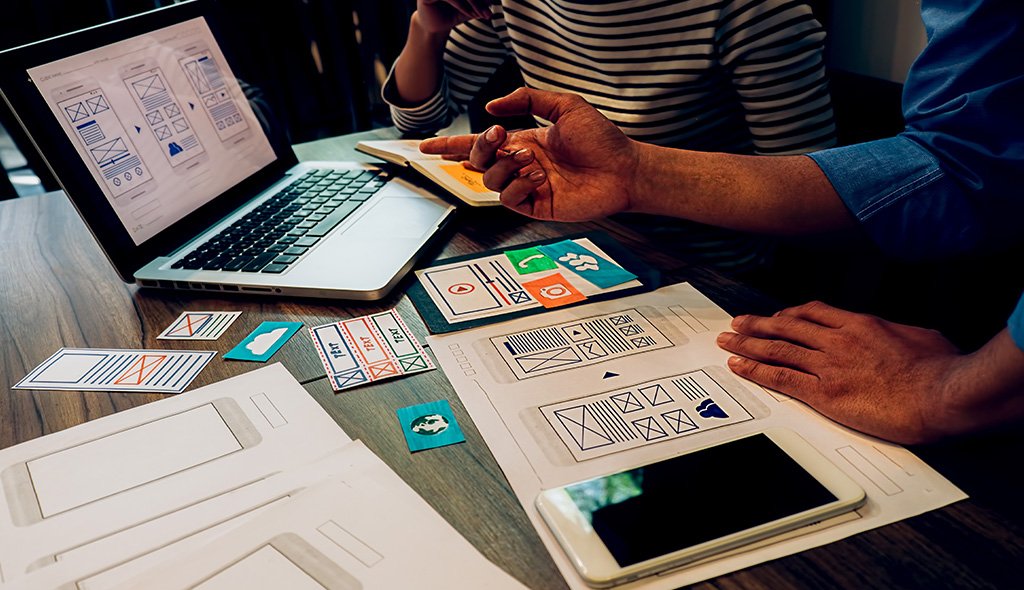
We translate defined structures into interactive prototypes that simulate the product experience at varying fidelity levels. Low-fidelity concepts test structural decisions while high-fidelity prototypes validate visual design, interaction patterns, and content hierarchy. This phase enables rapid experimentation and stakeholder feedback without the cost of engineering implementation, saving significant resources before development begins.

Prototypes undergo structured usability testing with representative users. We observe behavior, identify confusion patterns, and measure task success against defined benchmarks. Findings drive targeted design refinements that strengthen the product before handoff. This validation cycle ensures that engineering teams build a product already proven to work for its intended audience.

We finalize the product design into production-ready specifications, annotated prototypes, component documentation, and interaction guidelines. Our designers remain engaged during implementation to review builds, clarify design intent, and approve visual fidelity. Post-launch, we support initial performance review and iteration planning to ensure the product continues improving based on real usage data.
Explore outcomes from over 1,000 client engagements where our product design practice shaped digital products that achieved measurable results.
Product design demands more than visual skill or usability knowledge in isolation. It requires understanding how products fit within market ecosystems, user workflows, and business models. Our team works with organizations across all growth stages, from startups defining their first viable product to enterprises restructuring legacy platforms for modern audiences. Scalability, compliance readiness, and cross-platform coherence guide every product design and development services engagement.
We have delivered product design solutions across healthcare, fintech, ecommerce, real estate, education, logistics, media, and enterprise SaaS. This breadth means our designers bring sector-specific product knowledge including regulatory patterns, user expectations, and competitive differentiation strategies to every engagement. When you hire product designers with this cross-industry depth, you access product thinking that has been validated across hundreds of live digital products serving diverse audiences.

In a market where product design is often positioned as a visual layer applied after strategic decisions are made, our team has earned recognition for treating it as a core product function. The distinction lies in ownership breadth, validation discipline, and the cross-functional integration that ensures design decisions survive contact with engineering and market reality.
Strategy-to-Ship Continuity: Our product designers stay engaged from initial strategy through launch and post-release iteration, ensuring design intent is never lost between handoffs.
Cross-Functional Integration: Our designers work alongside product managers and engineers daily, resolving trade-offs in real time instead of creating artifacts in isolation.
Metrics-Informed Iteration: We define product success metrics at engagement start and use post-launch data to drive design iterations that improve adoption, retention, and task efficiency.
We use industry-leading strategy, design, prototyping, and collaboration platforms to deliver product design work that integrates seamlessly with modern product management and engineering workflows.









UX Stalwarts didn’t just fill a role—they found us a strategic product design partner who transformed our product velocity and revenue trajectory. Sarah joining our team increased our design throughput by 280 percent, enabling us to ship 12 major features in 9 months versus our previous pace of 4 annually, which directly unblocked our entire product roadmap. Within six months, Sarah had elevated our entire team’s design thinking and established processes that will serve us for years. UX Stalwarts’ deep understanding of what distinguishes a truly senior product designer from other design roles ensured we got exactly the strategic partner we needed.
UX Stalwarts found us exactly the specialized growth design talent we needed to transform our trial conversion performance. Marcus joining our growth team increased our trial-to-paid conversion by 167 percent from 4.8 to 12.8 percent over 11 months, which translated directly to $6.4 million in estimated annual recurring revenue from the additional paying customers we acquired. His impact extended beyond just conversion numbers to elevating our entire growth team’s effectiveness by enabling data-informed decisions and professional execution. This hire proved that specialized growth design expertise delivers measurable business results.
UX Stalwarts found us the perfect mid-level product designer who has grown with our company and delivered impact far beyond what we expected for the level. Alex increasing our product velocity 5x from 8-week to 1.6-week feature cycle times by establishing efficient design-engineering collaboration and eliminating UI bottlenecks proved that a strong product designer multiplies an entire engineering team’s effectiveness.Our engineers giving him a 9.4 out of 10 satisfaction score and implementation questions dropping 73 percent showed that he bridged the design-engineering gap beautifully. For a Series A company with budget constraints, hiring the right mid-level designer who could grow with us rather than an expensive senior proved to be exactly the right decision.
Considering a product design partner? Here are the answers that help product leaders make informed decisions.
A UX designer focuses primarily on research, usability, and the structural quality of user experiences. A product designer encompasses that scope but extends it to include product strategy, cross-functional collaboration with engineering and business teams, feature prioritization, and full-lifecycle ownership from concept through post-launch iteration. Product designers bridge the gap between what users need, what the business requires, and what technology can deliver. When you hire product designers, you bring in professionals who own the holistic product experience rather than contributing to one phase of the design process. Both roles create value, but product design carries broader strategic accountability.
Costs depend on engagement scope, designer seniority, project duration, and the depth of research and prototyping involved. A product design agency typically offers fixed-project pricing, monthly retainers, or hourly engagement models. For a focused product sprint, costs are modest. For a full-lifecycle product design engagement spanning strategy, research, prototyping, and post-launch iteration, the investment is higher but reflects comprehensive product ownership. Agencies in India offer globally competitive rates without compromising on strategic depth or execution quality. Request a detailed scope breakdown that specifies deliverables, milestones, and validation checkpoints before comparing proposals.
Evaluate their portfolio for evidence of strategic product thinking, not just visual polish. Strong product design companies will show case studies that explain how they identified user problems, made trade-off decisions, collaborated with engineering teams, and measured results after launch. Ask about their research methodology, prototyping approach, and how they handle scope changes during engagement. Check whether they assign dedicated product designers or rotate generalists across projects. Client retention rates indicate consistent delivery quality. The best product design companies demonstrate clear methodology and deliver outcomes tied to product metrics rather than just design artifacts. Reputable hire product designer firms also publish transparent process documentation and pricing models.
Timeline varies by product complexity and engagement scope. A focused concept validation sprint can take three to five weeks. A complete product design and development services engagement covering strategy, research, definition, prototyping, testing, and delivery typically runs twelve to twenty weeks. Factors that influence duration include the number of user segments, flow complexity, stakeholder review cadence, and whether usability testing cycles are included. We provide detailed timeline estimates during the alignment phase, with milestone checkpoints that give your team visibility and control over progress throughout every stage.
Yes. We offer flexible engagement structures including sprint-based projects, fixed-scope assignments, and short-term team augmentation. If you need to hire a product designer for a four-week concept sprint, a usability audit, or a feature design cycle, we structure the engagement to match your timeline and capacity needs. Short-term projects follow the same strategic rigor and validation discipline as longer engagements. Defining scope and success criteria upfront ensures that compressed timelines produce complete, actionable outcomes rather than unfinished explorations that require additional cycles to become useful.
Our teams have delivered product design across healthcare, fintech, ecommerce, real estate, education, logistics, media, and enterprise SaaS. Each sector demands distinct product considerations. Healthcare products require accessibility, regulatory compliance, and patient safety. Fintech products need trust calibration and complex data presentation. Ecommerce products focus on conversion optimization and discovery flows. As a ui ux product design agency with deep vertical expertise, our designers bring domain-specific product knowledge to every engagement, which accelerates decision-making and reduces the learning curve that costs time when designers lack sector-specific familiarity.
A traditional design studio typically focuses on visual identity, branding, and static deliverables. A digital product design agency specializes in interactive, user-facing products that require research, information architecture, interaction design, prototyping, usability validation, and ongoing iteration. The scope extends beyond how something looks to how it works, how users navigate it, and how it achieves business objectives. When you hire product design agency capabilities, you access a team that operates within product development workflows, collaborates with engineers and product managers, and measures success through product performance, not just aesthetic quality.
Deliverables depend on engagement scope but typically include product strategy documentation, user research reports, persona frameworks, journey maps, information architecture diagrams, wireframes, interactive prototypes, usability test reports, visual design systems, and annotated interaction specifications. For longer engagements, we deliver design system governance frameworks that ensure consistency as the product scales. Every artifact is built for actionability. We document design rationale alongside visual outputs so your engineering and product teams understand the reasoning behind each decision.
Our product designers embed directly into cross-functional workflows. They participate in sprint planning, attend engineering standups when appropriate, and maintain open communication channels for real-time design clarification. During build cycles, designers review implementations against design specifications and flag discrepancies before they compound. We use shared tools like Figma, Zeplin, and Jira to maintain a single source of truth for design decisions and implementation status. This interaction design collaboration model prevents the “design vs. development” friction that delays releases and degrades product quality.
Affordability in product design depends on right-sizing scope to your product stage. For early-stage products, a focused concept validation sprint covering research, wireframing, and prototype testing delivers maximum insight at modest cost. For mature products, targeted design interventions on specific flows or features avoid the expense of full redesigns. Digital product design services from India-based teams offer globally competitive pricing with senior-level strategic depth. The key is ensuring that even budget-conscious engagements include user validation so that design decisions are evidence-backed rather than assumption-driven.
Some engagement models do include designers with front-end development capabilities, particularly for prototyping and design system implementation. However, we recommend keeping product design and engineering as distinct responsibilities for most projects. Product designers make stronger strategic decisions when they are not simultaneously responsible for code output. That said, our designers produce specifications detailed enough that development teams can implement with minimal interpretation, and we offer product design and development company capabilities through coordinated teams where designers and developers work in parallel within shared workflows. Some clients hire product development designer talent for prototyping, or hire product design developers for handoff-ready output. Others hire product development designers full-time alongside hire product design developers, each hire product development designer adding code-aware decisions.
We define product success metrics during the alignment phase, tailored to your business goals. Common metrics include onboarding completion rates, feature adoption, task success rates, time-on-task, error frequency, support ticket volume, and retention curves. We establish baselines before design work begins and track movement after implementation. This approach ensures design impact is quantifiable and reportable to leadership. Our blog on quantifying the ROI of UX design explores this measurement framework in greater detail. We believe design investment should be evaluated by the same standards as any other business function.
When international companies hire product designers from an India-based agency, they access strategically skilled talent at rates substantially lower than US or European markets. This cost advantage does not reduce capability. Indian digital product design company teams employ designers trained in global product methodologies, fluent in English, and experienced in remote collaboration across time zones. The time zone overlap with European and Asian markets supports real-time communication, and flexible scheduling accommodates US-based teams. The result is expert product design services agency delivery with strong collaboration, cultural adaptability, and meaningful cost efficiency. Many international teams hire digital product designers from Indian agencies for full-lifecycle ownership.
Freelancers can work well for narrow, well-defined tasks. But product design requires coordination across research, strategy, interaction design, visual systems, and engineering handoff. An agency provides this integrated team with shared methodology, quality oversight, and project management. When you hire product designer agency capabilities, you gain continuity: if priorities shift or capacity needs change, the methodology and product context remain intact. For complex products or ongoing engagements, a product design services agency model delivers more consistent quality and broader capability than individual freelancers working without shared process infrastructure. Established hire product designer firms invest in continuous methodology refinement and quality oversight.
Review their portfolio for evidence of end-to-end product work, not just isolated visual deliverables. Ask for case studies showing how they navigated strategic trade-offs and measured product impact. Evaluate process transparency: a strong digital product design agency will explain their methodology, collaboration model, and validation approach before engagement begins. Request references from clients with comparable product complexity. UX Stalwarts offers structured pilot engagements where you experience our product thinking, communication quality, and delivery standards firsthand before committing to a full-scale partnership. This approach reduces risk and builds mutual confidence. Whether you hire product design agency support or hire product designer agency partners, evaluate methodology depth first.

C – 81C, Sector – 8, Noida 201301, India


1025 Beamon Drive, Franklin 37064 Tennessee, USA
Sveavagen 34 111 34 Stockholm, Sweden
A-10, Sahastradhara Rd, Doon IT Park, Dehradun, Uttarakhand

© 2026 UX STALWARTS. All rights reserved.