
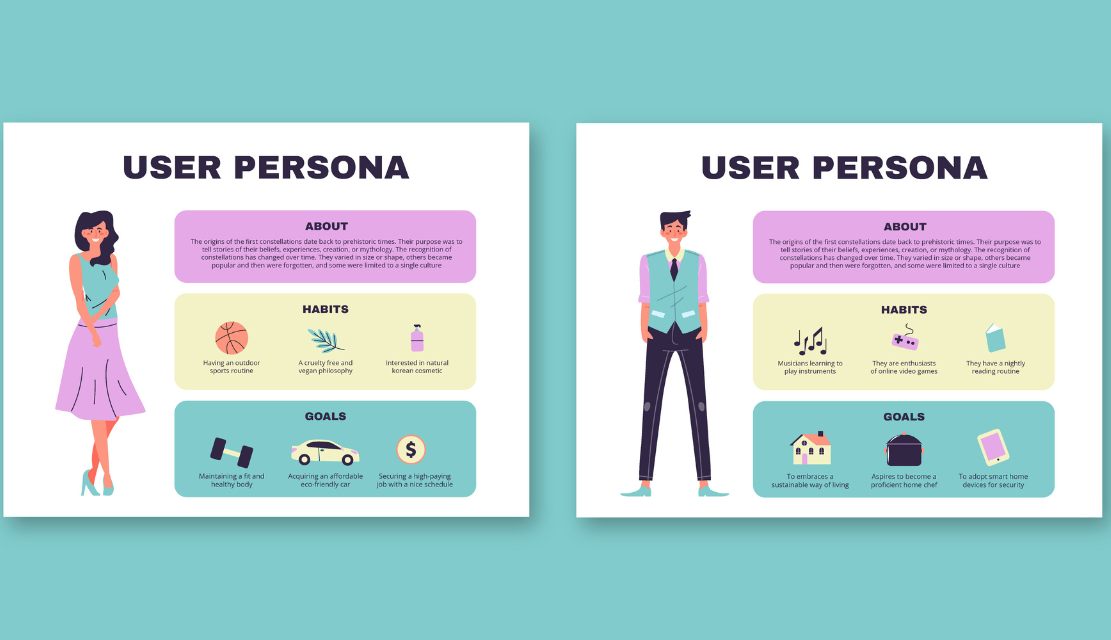
Every design decision is a decision about people. Who will use this product? What are they trying to accomplish? Where do they get stuck? User personas answer these questions by translating real research into clear, memorable profiles that keep teams focused on the humans behind the screens.
But personas only work when they are built correctly. Too many teams treat them as creative exercises, filling in fictional biographies with stock photos and invented hobbies. That approach produces wall decorations, not design tools. As the Nielsen Norman Group emphasizes, effective personas are grounded in concrete user research, not assumptions or aspirations. They represent behavioral patterns observed across real users, not a single imaginary individual.
This guide covers what user personas actually are, how to create them from real data, what to include and what to leave out, and how to keep them useful throughout the product lifecycle.
A user persona is a research-based profile that represents a key segment of your product’s audience. It captures goals, behaviors, pain points, and decision-making patterns in a format that the entire team can reference during design, development, and strategy discussions.
A strong persona is not a demographic snapshot. Knowing that a user is “female, 34, lives in Bangalore” tells a design team almost nothing actionable. Knowing that she manages procurement for a mid-size manufacturer, evaluates vendors based on integration speed, and abandons software trials that require more than two onboarding calls gives the team specific design direction.
Personas work because they exploit a natural human tendency: people relate more easily to a named individual with concrete characteristics than to abstract data segments. A persona named “Priya, Procurement Lead” is more memorable and more actionable than “Segment B: Mid-market decision-makers aged 30 to 40.” The research behind both may be identical, but the persona format makes it usable in daily design conversations.
These two terms are often used interchangeably, but they serve different purposes. Confusing them leads to misaligned design decisions.
A user persona focuses on the person who interacts with the product. It captures tasks, workflows, frustrations, and goals related to how they use the software, app, or platform. It informs information architecture, navigation, content hierarchy, and interaction patterns.
A buyer persona focuses on the person who makes the purchase decision. It captures motivations, objections, budget authority, and evaluation criteria. It informs marketing messaging, sales collateral, and pricing strategy.
In many B2B products, the buyer and the user are different people entirely. The CTO who signs the contract is not the analyst who uses the dashboard eight hours a day. Designing for the buyer’s priorities while ignoring the user’s workflow is how products get purchased but never adopted. Effective product teams build both types and know which to apply at each stage of the design process.
Start with direct user contact. Interviews, contextual observations, and usability tests reveal behavioral patterns that analytics alone cannot surface. Combine these qualitative insights with quantitative data from product analytics, support tickets, survey responses, and CRM records.
The goal is to identify recurring patterns, not to document individual users. Look for clusters of shared behaviors, common frustrations, similar goals, and repeated decision-making sequences. Pay attention to the language users choose when describing their work, their challenges, and their expectations. That language often reveals priorities that structured survey questions miss.
A minimum of five to eight interviews per user segment is a practical starting point. Teams with more resources can extend to 15 or more, but the critical threshold is the point where new interviews stop revealing new patterns.
Group your findings by behavior, not demographics. Users who share the same job title may use your product in completely different ways. A financial analyst who relies on automated reports has different needs than one who builds custom queries manually, even if they sit in the same department.
Look for patterns in:
These clusters become the foundation of your personas. Most products need two to four personas. More than that, and the team loses focus. Fewer, and you risk collapsing genuinely different user types into a single generic profile.
A useful persona is concise. It fits on a single page and includes only information that drives design decisions. The standard structure includes:
Leave out details that do not influence design. Hobbies, favorite coffee brands, and personality types add length without adding value. Every element in the persona should answer the question: “Does this help the team make a better design decision?”
Before finalizing, validate your personas with customer-facing teams. Sales, support, and customer success teams interact with users daily. They can confirm whether your personas ring true or flag blind spots in your research. If a persona does not match what frontline teams observe in real conversations, it needs revision.
Once validated, make personas visible and accessible. Store them in shared tools like Confluence, Notion, or your design system documentation. Reference them in design reviews, sprint planning, and feature prioritization discussions. A persona that lives only in a research deck has no impact on the product. The teams that get the most value from personas are the ones that treat them as active decision-making tools, not passive documentation.
Building from assumptions instead of research. Proto-personas created in a workshop are useful as starting hypotheses. They become dangerous when treated as validated profiles. Always label assumption-based personas clearly and commit to replacing them with research-backed versions.
Overloading with irrelevant detail. A persona for an invoicing application does not need to mention that the user enjoys mountain biking. Extra detail dilutes focus and signals that the persona was built for decoration, not decision-making.
Creating a single “average” persona. The average user does not exist. Segments do. Collapsing all users into one persona erases the behavioral differences that should drive distinct design decisions for distinct user types.
Freezing personas after launch. User needs evolve. Products change. Markets shift. Personas should be revisited at least every six months, or whenever major new research or analytics data becomes available. Treat them as living documents, not artifacts from the discovery phase.
Any ui ux design services company working with enterprise clients knows that outdated personas lead to misaligned roadmaps and wasted development effort. Keeping personas current is not optional. It is a core part of maintaining product-market fit.
Personas are not just a design tool. They are a strategic alignment mechanism. When product, engineering, marketing, and leadership teams share a common understanding of who they are building for, decision-making becomes faster and more consistent.
Personas inform feature prioritization by clarifying which capabilities serve the highest-value user segments. They reduce scope creep by giving teams a clear filter: “Does this serve Priya’s workflow, or are we adding complexity for an edge case?” They improve onboarding by helping teams design activation flows matched to each persona’s technical proficiency and goals.
Organizations that embed personas into their product process consistently see improvements in adoption, retention, and user satisfaction. The connection is direct: when you design for a clearly defined user, the product fits better, and users stay longer.
For teams that lack in-house research capacity, partnering with a provider of ui ux services that specializes in persona development and UX research ensures that personas are built on rigorous methodology rather than internal guesswork.
User personas are one of the most powerful tools in product design, but only when they are built on real data, structured for actionability, and maintained over time. They turn abstract audiences into concrete people with specific needs, giving every team member a shared reference point for decision-making.
The difference between a product that feels intuitive and one that feels generic often comes down to how well the team understood its users. Personas are how that understanding gets built, documented, and applied. Invest in the research, keep the format lean, and use them in every conversation where the user’s perspective matters.
Talk to UX Stalwarts about building research-backed personas for your product
A user persona is a research-based profile that represents a key segment of your product’s audience. It captures goals, behaviors, frustrations, and decision-making patterns in a concise format that design and product teams can reference during daily work. Unlike demographic segments, personas focus on behavioral patterns observed across real users, making them actionable for design, development, and strategy decisions.
Most products benefit from two to four personas. Fewer than two risks collapsing genuinely different user types into a single generic profile. More than four makes it difficult for teams to keep all personas in mind during design reviews and prioritization discussions. The right number depends on the behavioral diversity observed in your user research, not the number of market segments your business targets.
A user persona focuses on the person who uses the product, capturing their tasks, workflows, and frustrations. A buyer persona focuses on the person who makes the purchase decision, capturing their motivations, objections, and evaluation criteria. In B2B products, these are often different people. Designing only for the buyer can result in products that get purchased but never adopted by the actual users.
Personas should be reviewed at least every six months, or whenever major product changes, new research findings, or significant shifts in analytics data occur. User behaviors and needs evolve over time, and personas that are not updated become misleading. Treating personas as living documents rather than static deliverables ensures they continue to drive accurate design decisions.
AI tools can accelerate persona creation by synthesizing data from analytics, support tickets, and survey responses. However, they cannot replace direct user contact. Interviews and observations reveal motivations, emotions, and contextual factors that AI models cannot reliably infer from behavioral data alone. The most effective approach uses AI to generate initial drafts and identify patterns, then validates and enriches those drafts through qualitative research with real users.

C – 81C, Sector – 8, Noida 201301, India


1025 Beamon Drive, Franklin 37064 Tennessee, USA
Sveavagen 34 111 34 Stockholm, Sweden
A-10, Sahastradhara Rd, Doon IT Park, Dehradun, Uttarakhand

© 2026 UX STALWARTS. All rights reserved.

