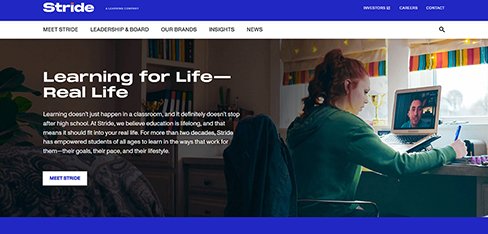
Learning products fail quietly. A student opens an app, taps twice, and closes it forever. A teacher abandons a gradebook that takes ten clicks to mark attendance. A parent stops checking progress when the dashboard confuses rather than informs. Poor Education UI UX design shows up as falling course completion rates, dropped daily active learners, declining teacher adoption, and renewal conversations that grow harder every year. Most platforms lose more users to preventable friction than to content gaps. In education, a single confusing screen can undo months of pedagogical work, and every broken flow costs institutions the trust they need most.
Our approach starts with the real classroom. Before any screen is produced, our team observes how students actually engage with content, how teachers move through their day, and how administrators make enrollment or reporting decisions. From there we deliver research-backed information architecture, engagement-aware interface design, multi-role dashboards, assessment flows, and component libraries tuned for content-heavy platforms. As a specialized education ui ux design agency, we work across learning management systems, student apps, tutor marketplaces, parent portals, and administrative consoles. Every screen is scoped to move specific metrics: course completion, teacher weekly active usage, parent engagement scores, and assessment submission rates. Nothing gets designed for appearance alone.
Eighteen years of design experience across thirty-plus countries gives our team a working understanding of what learning actually feels like, from primary classrooms in Delhi to university lecture halls in Stockholm. UX Stalwarts has partnered with early-stage edtech founders launching first cohorts and with large institutions modernizing decade-old student information systems. Our designers read pedagogy research, sit in on classroom sessions, and work closely with educators rather than guessing what teaching requires. That grounding separates surface polish from an education product design agency capable of owning learner outcomes. We commit to the completion or retention number each screen is built to improve, and stay accountable until the product proves it in real classrooms.

Generic UX research misses what happens in actual classrooms. Our discovery process includes teacher shadowing, student interviews across age groups, and observation sessions in real learning environments. Design decisions stay grounded in evidence from the specific learners, educators, and contexts your platform actually serves.

Learning science shapes design decisions, not visual trends. Spaced repetition, cognitive load theory, feedback timing, and progress visibility are built into interfaces rather than added as features. Our team reads education research and applies proven learning principles throughout every screen your users encounter.

Education platforms serve students, teachers, administrators, and parents simultaneously. Each role has different goals, different comfort with technology, and different windows of available attention. Our team designs for each stakeholder distinctly, rather than forcing one interface to satisfy everyone and frustrating them all.

Education products serve young users, disabled learners, and institutions bound by COPPA, FERPA, GDPR, and WCAG 2.2 accessibility standards. Compliance is designed in from the first wireframe, not added during legal review. This protects institutional buyers from risk and ensures learning reaches every student equally.

Gamification done poorly trains learners to chase rewards instead of mastery. Our approach balances motivation cues with genuine educational value, using progress visualization, meaningful milestones, and honest feedback loops. Students stay engaged because the learning feels worthwhile, not because the screen keeps buzzing at them.

Shipping an interface is only half the work. Our team stays engaged through teacher onboarding content, admin training materials, and first-semester observation cycles. Weekly syncs, shared Figma spaces, and direct designer access mean your rollout teams have a partner rather than a vendor.

Education interfaces are not consumer apps dressed with educational content. Confusing navigation costs a student confidence. A cluttered teacher dashboard steals minutes from every class period. An unclear parent report breaks trust an institution spent years building. Strong education ui ux design shapes behavior in ways that compound: daily active learners grow, course completion rates climb, and word-of-mouth adoption spreads through staff rooms and parent groups. A thoughtful elearning ui ux design company brings literacy in learning psychology, role-specific workflows, and the moments attention breaks down during study.
Partner with specialists who design learning products that last.
Every engagement follows a deliberate path built to protect pedagogical integrity while shipping learning products people actually complete.

We begin by meeting your real users. Students across target age groups, teachers across subject areas, and administrators are interviewed alongside parents where relevant. Existing usage analytics, support tickets, and content drop-off patterns establish a measurable baseline the new design must improve.

Education platforms serve multiple roles with distinct needs. We separate student, teacher, admin, parent, and tutor journeys into independent maps that document daily workflows, emotional states, device contexts, and attention spans. These maps guide every design decision so one role never gets sacrificed for another.

Learning science drives structure. Content sequencing, assessment placement, feedback timing, and progress visualization are mapped against proven pedagogical principles before any screen is wireframed. Subject matter experts and educators validate flow logic so the platform supports real teaching rather than forcing educators into unnatural workflows.

High-fidelity screens and a component library tuned for content-heavy learning products ship together. Typography scales for extended reading, video player patterns, assessment question types, progress indicators, and reward cues are designed with accessibility contrast and multi-language support built in from day one.

Designs are tested with real students and teachers in actual learning environments before development. We measure task completion, content comprehension, time on task, and engagement signals across age groups. Findings drive documented revisions so the final interface earns its place in teaching and study contexts.

Post-launch, real classroom data replaces assumption. Course completion, teacher weekly active usage, student return frequency, and support ticket categories are monitored against the Phase One baseline. Where gaps emerge, revisions ship in structured sprints so the product keeps earning institutional trust term after term.
Drawn from over one thousand engagements, these projects reflect measurable outcomes shipped to learners, teachers, and institutions worldwide.
Core values behind every learning engagement are pedagogical integrity, accessibility, and scalable performance. Teams evaluating an education website design agency weigh depth of classroom understanding against execution speed, and both matter here. From pre-launch edtech founders piloting first cohorts to large school networks modernizing decade-old systems, our team operates across the maturity spectrum. Design decisions balance immediate learner needs against architectural runway for content growth.
Industry coverage spans K-12 learning platforms, higher education portals, corporate training tools, tutor marketplaces, parent communication apps, exam and certification systems, language learning, and skill development products. Our education app design agency work pairs with education software design services engagements across public, private, and supplementary learning sectors, translating classroom realities into interfaces that teachers recommend voluntarily.

Recognition arrives through consistency. UX Stalwarts earns trust through steady delivery as an education ui ux design agency. Our work has been cited in edtech publications, shortlisted for education design awards, and referenced in institutional case studies because the output raises completion rates and teacher satisfaction. Three commitments explain why learning organizations select our team.
Pedagogy Shapes Every Decision: Learning science drives the structure, the sequence, and the feedback logic, not trending visual patterns or competitor mimicry.
Multi-Role Design Fluency: Students, teachers, administrators, and parents each get interfaces that fit their actual workflow and attention budget.
Accessibility As Standard: WCAG, COPPA, and FERPA readiness is baked into every screen, protecting institutional buyers and serving every learner.
Our studio uses category-leading tools selected for collaboration depth, engineering handoff accuracy, and accessibility testing integration across every online learning platform design services engagement.









One in three virtual students was dropping out and session times were barely 12 minutes. UX Stalwarts transformed our platform with gamified progress tracking and interactive classrooms that keep students engaged. Retention improving by 44 percent and session times more than doubling demonstrated that virtual learning can match traditional school engagement with the right design.
Our students were wasting 40 percent of study time reviewing content they already knew while struggling silently on topics they did not understand. UX Stalwarts designed an adaptive interface that meets each student where they are. Assessment scores improving 32 percent and time-to-competency dropping 22 percent proved that personalized learning pathways deliver real educational outcomes.
Nearly three-quarters of interested students abandoned our enrollment process. For working adults juggling jobs and families, the friction was just too high. UX Stalwarts removed every unnecessary barrier with save-and-resume enrollment, flexible scheduling, and instant financial aid estimation. Enrollment increasing 56 percent proved that accessible design expands educational opportunity.
The questions learning leaders ask before choosing a design partner.
Start with classroom specificity. A generalist team that has never shipped a student dashboard will miss the exact places learners disengage. An education website design agency with proven K-12 or higher ed experience understands content density, reading age considerations, and parent communication patterns that general web portfolios never cover. Ask for before-and-after completion rate numbers rather than aesthetic case studies. Check teacher and admin feedback from prior launches. Review component libraries designed for accessibility. Evaluating education website ui ux design specifically means looking at institutional deployments, not just consumer apps. Credible education ui ux design services defend their decisions to pedagogy leads, product teams, and compliance officers in one meeting. School website design agency expectations apply.
Pricing for education ui ux design services varies with scope, learner age range, and platform complexity. A focused UX audit on an existing learning app typically starts in the low five figures. A complete online learning platform design services engagement covering research, role mapping, interface design, and component library usually runs mid-five to low-six figures. Enterprise programs involving school networks, multi-district rollouts, or ongoing optimization reach higher. Variables that move price are number of role types served, accessibility requirements, language or localization scope, and depth of post-launch iteration support needed. Transparent scoping before contract signature prevents surprises during execution. Educational website ui ux design firms scope similarly. Educational website ui ux design solutions match this. Educational website ui ux design companies bracket alike.
Timelines depend on scope and classroom complexity. A targeted UX audit with prioritized recommendations typically takes three to four weeks. A single-flow redesign like student onboarding or gradebook interaction runs six to eight weeks including validation. A complete education app design services engagement covering discovery, role mapping, interfaces, and component library generally runs twelve to twenty weeks. Full ui ux design for education platform rebuilds involving multiple user role types, language support, or new platform migrations extend further. We scope in two-week milestones with visible deliverables at each checkpoint so your institutional team can evaluate progress and redirect priorities as real student and teacher feedback emerges from pilot cohorts. Educational website ui ux design company timelines align.
A structured engagement follows six sequential phases. First, learner discovery collects student, teacher, admin, and parent interviews alongside existing analytics. Second, role mapping separates each user type into independent journey documents. Third, pedagogy alignment validates content sequencing and assessment logic against proven learning science. Fourth, engagement interface work produces high-fidelity screens and a component library. Fifth, classroom validation tests designs with real students and teachers before development begins. Sixth, post-launch adoption tracking measures whether the intended learning behavior actually occurs. Each phase ends with a signed-off deliverable. This disciplined sequencing is why our education app ui ux design, education software design services, and ui ux design for education platform engagements protect timeline integrity.
Three things separate our learning work. First, pedagogy shapes every decision rather than visual trends. Spaced repetition, feedback timing, and cognitive load principles are built into interfaces from the first wireframe. Second, multi-role fluency. Most teams design for one user type and retrofit the rest; we design each role distinctly from the start. Third, accessibility is designed in, not bolted on later, protecting institutions from WCAG, COPPA, and FERPA risk. A specialized ui ux agency for education platform work, or focused ui ux design for school software engagements, carries context that generalist studios learn slowly. Our education product design agency approach prioritizes learner outcomes over file polish. Education app ui ux design company pattern repeats.
Starting is deliberately lightweight. A brief discovery conversation covers platform stage, primary learner segments, technology stack, known pain points, and desired outcomes. Within five working days we return a scoped proposal covering phased milestones, deliverable samples, team composition, timeline, and commercial terms. A paid pilot sprint is available for teams wanting to test chemistry before committing. Most clients move from first call to kickoff within two weeks. You can begin with a short-form enquiry, share platform documentation under NDA, or explore related capabilities through our broader UX design services page as a starting reference. Educational website design agency credentials matter equally. Online learning platform design firms qualify here. Educational website ui ux design company patterns recur. Education website ui ux design services compound similarly.
Several adjacent capabilities compound the impact of learning platform design. A mature design system accelerates every new feature release and protects consistency across student app, teacher dashboard, and admin console. Dedicated usability testing validates assumptions with real students before engineering cycles are committed. Brand identity aligns visual language across product, marketing, and classroom materials. Motion design adds feedback signals to assessment and progress moments. Accessibility audits ensure WCAG compliance for institutional buyers. School software design agency work and broader elearning ui ux services often pair with these adjacent services to deliver complete platforms rather than isolated interfaces. Educational website design agency support reinforces this. Online learning platform design firms align too. Educational website ui ux design agency capabilities extend further. Educational website ui ux design companies match scope.
Every engagement is scoped around the specific learning product, not a template. A K-12 literacy app has different needs than a corporate compliance training dashboard. A higher education enrollment portal requires different hierarchy than a tutor marketplace. Our education website ui ux design work for universities looks different from education app ui ux design and mobile app design for education engagements for young learners. Discovery produces a custom engagement plan accounting for learner age, subject matter, accessibility requirements, institutional workflow, and commercial priorities. Sprint cadence, deliverable format, and stakeholder involvement all adjust to match how your organization makes decisions. The quality bar stays constant. Education website ui ux design company engagements adapt. School website design agency work scales similarly.
Yes, and it is usually where meaningful learning wins happen. After launch, real student and teacher behavior often differs from research predictions in small but important ways. Retainer options cover ongoing design iteration, component library expansion, new feature releases, periodic classroom usability studies, and analytics-driven optimization of engagement flows. Elearning ui ux services and ongoing elearning ui ux design retainers also handle seasonal updates around academic calendars, exam seasons, and admissions cycles. Some clients retain the team monthly; others call quarterly for focused sprints on metrics that need to move. Elearning ui ux design services apply here. Education website ui ux design services match cadence. Remote testing plays a central role here, covered in our guide to remote usability testing.
Coverage spans K-12 platforms, higher education portals, early childhood apps, corporate training systems, tutor marketplaces, exam prep tools, vocational training, language learning, and supplementary coaching platforms. Clients range from pre-launch founders to listed education companies operating across India, the United States, the Middle East, and Europe. Our education app design agency experience extends from primary readers aged five through to adult professional certification learners. Pattern transfer across age groups is deliberate: a proven progress visualization for young learners often inspires better cues for adult professional learners. As a ui ux agency for education platform engagements, we bring the same design rigor to every age and vertical served.
Engagement design requires restraint. Our approach distinguishes between shallow gamification that trains reward-chasing and deep motivation that supports actual learning. We use four techniques. First, meaningful progress visualization shows what learners have mastered, not just what they clicked. Second, feedback arrives at the moment it helps learning, not immediately after every tap. Third, milestones tie to real skill development rather than streak counting. Fourth, social elements like cohort visibility are optional and privacy-respecting. The distinction matters across educational app design services and education app design services contexts; educators notice when engagement feels hollow and abandon platforms that treat students like slot machine users.
Accessibility shapes design inputs, not final reviews. Before wireframes begin, our team maps the regulatory framework governing your product: COPPA for young users, FERPA for student data, GDPR for European learners, WCAG 2.2 for accessibility, and regional education board requirements. Color contrast ratios, keyboard navigation, screen reader compatibility, and cognitive accessibility patterns are designed in from day one. Elearning ui ux design standards also demand captions for video lessons, transcript availability, and flexible text sizing. Institutional buyers and procurement teams review these early in the sales process. Our guide to UX accessibility audits explains our detailed approach. Elearning ui ux design services support audits too. Education website ui ux design company reviews align. Educational website ui ux design agency reviews follow.
Mobile learning now accounts for a significant share of student engagement, and design must reflect how students actually use phones in classroom and home contexts. Mobile app design for education prioritizes short session length, offline content access, and thumb-friendly navigation. Our educational app design services practice designs for interrupted attention, single-hand use, battery preservation, and low-bandwidth network conditions that match real student environments. Video lesson patterns, quiz interactions, note-taking tools, and reading modes all adapt to smaller screens without stripping away learning quality. Push notifications respect study hours and parental controls rather than hijacking attention outside appropriate windows. Educational website ui ux design solutions adapt similarly. Education app ui ux design company patterns mirror this. Educational website ui ux design firms adapt as well.
Yes. Education design systems carry specific requirements beyond general product systems. Components must handle multi-language content, adjustable reading levels, accessibility contrast states, progress visualization patterns, assessment question types, and regulatory disclosure blocks. Whether the engagement is ui ux design for school software or a broader higher education platform, school software design agency principles scale the build. Education dashboard design services engagements produce tokenized foundations, a production-ready component library, documented accessibility behavior, and developer handoff kits. For institutional platforms, long-term stewardship matters as much as the initial build, which we cover in our article on design system governance.
Measurement starts before design begins. During discovery, baseline metrics are captured for flows being redesigned: course completion, teacher weekly active usage, lesson engagement duration, assessment submission rates, and support ticket categories. After launch, the same metrics are re-measured at thirty, sixty, and ninety days. Secondary signals include daily active learners, feature adoption rate for new modules, accessibility compliance coverage, and reduced onboarding support requests. Quarterly reviews tie design decisions back to retention, renewal, and institutional satisfaction. Whether the project is education dashboard design services for administrators or an elearning ui ux design company engagement for learners, measurement discipline separates cosmetic redesigns from durable learning outcomes.

C – 81C, Sector – 8, Noida 201301, India


1025 Beamon Drive, Franklin 37064 Tennessee, USA
Sveavagen 34 111 34 Stockholm, Sweden
A-10, Sahastradhara Rd, Doon IT Park, Dehradun, Uttarakhand

© 2026 UX STALWARTS. All rights reserved.