
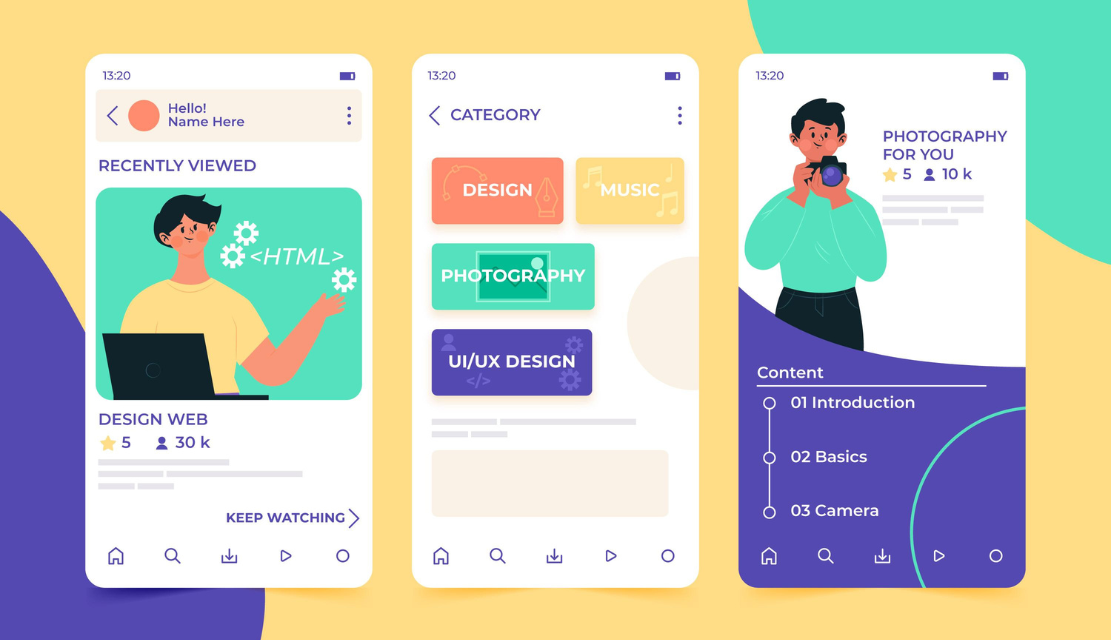
You have good content and qualified instructors in your EdTech platform and cutting-edge technology. But 73% users drop courses before finishing them. Average retention rates are in the area of 27%, while some platforms lose 90% of their users in 30 days. The problem isn’t your curriculum; it’s the experience. Students are quick to judge learning platforms, and they decide if the interface feels intuitive, engaging and is worth their time. One confusing navigational item, one overwhelming dashboard, or one poorly designed lesson flow and motivation is destroyed instantly. EdTech exists under a unique pressure: users aren’t consuming content for consumption’s sake – they’re investing their time, their effort, and, often, their money into their personal growth. And when platforms fail to keep people engaged, students don’t just churn; they give up on learning goals altogether, harming both business measures and educational ones.
EdTech retention has a direct effect on the viability of a business and student success. The statistics show huge opportunities. While average student retention is at 27%, those platforms with robust engagement features have seen 30% improved retention with an improvement in user satisfaction. This gap is millions of dollars of lost revenue and educational impact.
Day 30 retention for education apps averages out to be only 2% – one of the worst percentages for all types of apps. Many platforms have enormous drop-off rates after initial sign-up, with retention rates falling within weeks. This leads to unsustainable costs of customer acquisition, where platforms spend a lot on attracting customers to their platforms who never complete courses.
The financial implications go beyond subscriptions. Platforms that have higher completion rates produce better testimonials, word of mouth, and lower marketing costs. Institutions using structured engagement tools see retention gains of 25%, while improvements in course completion of 60% are possible through well-designed gamification.
Student engagement is a predictor of course completion, particularly for self-paced students who are hampered by barriers without pressure from a teacher. According to WebMD.com, fields such as computing have 33.2% non-completion rates that are attributed to barriers to engagement, which speaks volumes about the direct impact that UX design has on the outcome of education.
The global EdTech market is projected to grow from $220.5 billion in 2023 to projected $810.3 billion by 2033 – and yet, only platforms solving the engagement crisis will see this growth.
Effective EdTech UX uses the principles of learning psychology instead of generic app design patterns. Understanding how people learn, how they stay motivated and how they build habits shapes every interface decision.
Cognitive load theory requires just that, simplicity. Students processing new concepts can’t navigate complicated interfaces at the same time. Clean layouts that have a clear information hierarchy, so that learners are not overwhelmed. Bite-sized lessons are better than lengthy modules. Platforms that break content into focused chunks see better retention and comprehension.
Motivation needs constant feedback loops. Students must get immediate confirmation that hard work pays off. Progress bars, completion badges, and streak tracking help to provide visible evidence of progress. Duolingo does exactly that – 120-130 million monthly active users sustained by daily streaks and achievement notifications. This isn’t manipulation – it’s designing around human psychology that craves indicators of progress.
Social learning principles are of tremendous importance. Humans are more likely to learn with peer interaction and support from a community. Discussion forums, study groups, and collaborative features make studying together. Platforms with community features experience dramatically higher engagement in comparison to learning environments that are solo.
Personalisation touches the individual learning styles. Not all students take in things the same way. Some like to have things visually explained, some need hands-on practice, and many need repetition. AI-driven recommendations based on performance and behaviour can customise journeys – struggling students get simpler practice problems, advanced learners get difficult material. This is an adaptive approach because we are avoiding boredom and frustration at the same time.
Engagement occurs through intentional design decisions that are made throughout the journey of learning. First session experiences determine long-term retention. Platforms that have quick wins during the initial 10-15 minute sessions have much higher Day 1 and Day 7 retention. New users who complete one small lesson instantly feel accomplished as opposed to being overwhelmed by a long onboarding process.
Gamification is proven to improve engagement measurably when it is thoughtfully implemented. Points, badges, and leaderboards – they’re no gimmicks, they’re psychological triggers. Platforms with embedded elements of all three experience 2x engagement, 60% increase in course completion and 35% decrease in churn. The key is striking the balance between competition and encouragement – leaderboards should motivate, not scare.
Tracking progress helps to turn abstract learning into concrete achievement. Visual representations such as progress bars, streak counters, and milestone celebrations are habit loops. When students view “5-day learning streak” indicators, there is more pressure on them psychologically not to want to lose momentum. Duolingo’s success supports this – people come back to Duolingo each day specifically to avoid breaking streaks.
Interactive elements do not allow for passive consumption. Quizzes, polls, drag-and-drop activities, and instant feedback keep learners actively engaged as opposed to passively watching videos. Platforms that incorporate interactive tools have 42% improvements in participation as compared with static delivery of content.
Microlearning for busy adult schedules. Instead of lessons that last an hour or more, 5-10 minute modules fit into commutes, lunch breaks, and spare moments. Khan Academy’s bite-sized video tutorials show how splitting up difficult subjects into manageable portions makes the subject matter easier to understand and complete.
Retention involves more than initial excitement. When the implementation of respectful personalised push notifications works wonders for return rates. Time zone-aware messages with deep links to upcoming lessons are more effective than generic reminders. The key is relevance – notifications need to feel helpful rather than spammy.
Community features breed accountability and belonging. Discussion threads where students ask questions and share progress enable connections to be made outside of the confines of individual courses. Platforms such as Skillshare and Coursera illustrate the value that peer interaction and instructor engagement add to a person’s loyalty to the platform, in addition to the quality of the content provided.
Adaptive learning paths ensure appropriate levels of challenge. Too easy creates boredom, too difficult leads to frustration – both lead to abandonment. Systems that analyse performance and adjust difficulty keep students in a zone that is optimum for learning, where they’re challenged yet capable.
Properly segmented email campaigns bring back at-risk users. Students who have been inactive for certain periods receive specific messages related to their progress made, new content according to their interest or limited-time incentives. Segmenting by behaviour and characteristics allows for personalised outreach vs. one-size-fits-all messaging.
Regular updates of content and feature shows evolution of the platform. Students want assurance that their platform of choice keeps up with innovation. Announcing new courses, better tools, or better features draws people’s attention to the reasons why they subscribed in the first place.
Track metrics that reveal the health of engagement and retention. Daily Active Users (DAU) divided by Monthly Active Users (MAU) generates the stickiness ratio. Around 20% is good, above 25% is strong. This is an indication of how many monthly users come back each day — higher percentages are indicative of better engagement.
Course completion rates indicate the effectiveness of content and the quality of UX. Platforms should be able to track completion by type of course, segment of students, and time period. Sudden drops are problems to investigate – confusing lessons, technical issues, problems with difficulty where they should not be.
Session duration indicates depth of engagement. The average time spent by students per session is an indicator of content value. However, longer isn’t always better; it’s more important to learn efficiently than to take more time. Context is the key factor in what ideal duration.
Churn rate is the measure of users leaving the use of the platform. Analysing how and why students drop out sheds light on problems that can be fixed. Many leave because of disengagement, too much content or a lack of feeling that they are not getting anywhere. Exit surveys offer qualitative data to complement quantitative data.
Improvements in learning outcomes are the reason for platform value. Pre- and post-assessment scores illustrate educational impact above and beyond engagement metrics. Platforms measuring actual skill gains rather than just time spent build strong value propositions.
EdTech UX in 2026 focuses on AI-powered personalisation that will enable unique journeys for every learner. Systems analyse performance, preferences and behaviour to recommend the best content, pacing and formats. This is more than just the basic adaptive difficulty to learning styles and triggers to learn.
VR and AR make it possible to create immersive educational experiences that are not possible with traditional interfaces. Medical students rehearse procedures in virtual operating rooms, history students can explore ancient civilizations and language students can talk to AI-powered native speakers. These technologies make for better understanding and retention with the use of experiential learning.
Social learning features go beyond discussion forums into collaborative spaces in which students work together on projects, offer peer feedback, and develop learning communities. Platforms become ecosystems aligned with relationship vs. individual content delivery.
Voice interfaces make hands-free learning on the commute, while exercising, or doing household chores, possible. Students interact conversationally and get explanations right away, and make education fit into busy lives.
Use game mechanics to motivate effort, not trivialise content points. Badges are used to reward advancement on authentic learning goals and not empty interactions. Make sure that competition is encouraging, not discouraging, to struggling learners.
Quick first session wins, progress tracking, personalised push notifications, community features, and adaptive difficulty are all examples of measurable improvement in retention of 25-60% if well implemented.
Both, but mobile-first design is important. 55% of EdTech usage occurs on mobile. Deliver a flawless user experience on small screens while taking advantage of the desktop for complex activity.
Iterate continuously based on user feedback and engagement data. Small improvements regularly are better than infrequent major improvements. Announce updates to remind users of the platform evolution in progress.
New users are overwhelmed with complex UX. First experiences should have quick wins in 10-15 minutes, building confidence to introduce more advanced features or long lessons.
Track DAU/MAU RAT, course completion rate, session duration, churn rate and learning outcomes. An A/B test is a method of changing and comparing groups of people so that the impact on the UX can be isolated and distinguished from other variables.

C – 81C, Sector – 8, Noida 201301, India


1025 Beamon Drive, Franklin 37064 Tennessee, USA
Sveavagen 34 111 34 Stockholm, Sweden
A-10, Sahastradhara Rd, Doon IT Park, Dehradun, Uttarakhand

© 2026 UX STALWARTS. All rights reserved.

