Property platforms fail in silence. A buyer opens a listing portal, waits three seconds for map tiles to load, and closes the tab. An agent abandons a lead management tool that takes nine clicks to log a site visit. A developer showcase loads beautifully on desktop then collapses on the phone where seventy percent of property searches actually happen. Weak Real Estate UI UX Design shows up as lower qualified lead volume, higher cost per lead, slow listing turnaround, and agents who default back to WhatsApp and spreadsheets. In property, attention is fragile and competition is one scroll away. A single broken filter can cost a portal thousands of rupees in ad spend every hour.
Our approach treats the property platform as a conversion system, not a catalog. Before any screen is produced, our team analyzes search behavior by buyer segment, agent daily workflows, developer launch patterns, and the funnel steps where leads currently drop. From there we deliver research-backed information architecture, property detail page systems, map and filter interactions, lead capture flows, agent CRM dashboards, and component libraries tuned for high-volume listing data. As a specialized Real Estate UI UX Design Agency, we engineer the moments that matter: first listing impression, shortlist save, inquiry submission, site visit request. Every screen is scoped to move specific metrics like qualified lead rate, time to inquiry, and agent productivity.
Eighteen years of design experience across thirty-plus countries gives our team working fluency in how property is searched, shortlisted, and transacted across very different markets. UX Stalwarts has partnered with early-stage proptech founders launching rental marketplaces and with listed developers modernizing project showcase portals. Our designers speak the language of RERA disclosures, MLS feeds, IDX integrations, BHK configurations, lease structures, and brokerage commission models. That fluency separates a surface-level refresh from a real estate digital product design agency capable of owning conversion outcomes. Where generalist studios ship Figma files, we commit to the lead or transaction number each screen is built to move.

Generic personas miss how people actually shop for property. Our discovery combines search log analysis, recorded site visits with real buyers, broker ride-alongs, and interviews across first-time renters, investors, and family buyers. Every design decision stays grounded in how property seekers actually browse, compare, and commit across sessions.

Map performance is where most property portals lose buyers. Cluster behavior, zoom thresholds, polygon draw tools, filter density, and result list synchronization all require deliberate engineering rather than default component behavior. Our team has shipped map interfaces that stay responsive at ten thousand marker loads.

Property platforms serve seekers, agents, brokers, developers, and tenants simultaneously. Each audience has different goals, different data needs, and different usage rhythms. We design each workflow distinctly rather than forcing one interface to satisfy everyone, which is why agents actually adopt our dashboards rather than working around them.

Lead capture is funnel architecture, not form design. Trust signals, progressive disclosure, shortlist nudges, and inquiry timing are chosen from evidence. Forms that convert ask for less, not more, and our designs earn inquiry submissions without forcing buyers through barriers that push them to competitor platforms.

Property search happens on phones during commutes, lunch breaks, and late nights. Our designs start from mobile thumb zones, slow network conditions, and single-hand reachability. Virtual tours, floor plans, and photo galleries stay performant on weaker signals, because a perfect desktop experience loses to a decent mobile one every time.

Property timelines move with launches, regulatory deadlines, and seasonal buying cycles. Our collaboration model matches that pace with weekly product syncs, shared Figma spaces, written decision logs, and direct access to the senior designer owning your account. Deadlines stay honest because rollout pressure is real.
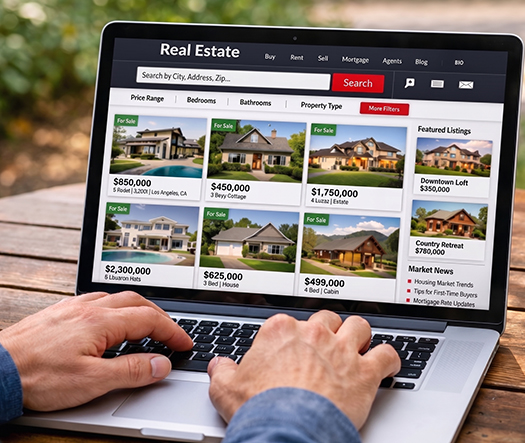
Property interfaces carry a measurable revenue consequence. A confusing search page buries good listings. An overloaded property detail view delays the inquiry tap. A clunky agent dashboard pushes brokers back to WhatsApp and Excel. Strong ui ux design for real estate changes the numbers that matter: qualified lead volume climbs, cost per lead drops, and shortlist-to-inquiry conversion improves without spending more on acquisition. A thoughtful real estate web design and UX agency understands buyer psychology, regulatory disclosures, and the exact moments hesitation turns into silence. Every screen is crafted to earn the next tap.
Partner with specialists who design property platforms built for conversion.
Every engagement follows a deliberate sequence built to reduce friction across seekers, agents, and operators while lifting conversion where it matters.

We begin by mapping the property market around your business: buyer segments, competitor portals, regulatory requirements like RERA or MLS rules, and the internal workflows of agents and operators. Analytics, call recordings, and inquiry data establish the measurable baseline every design decision must eventually improve.

Property search rarely happens in one session. We map multi-session journeys from first ad tap through shortlist, inquiry, site visit, and offer. Each step captures the seeker’s emotional state, decision criteria, comparison behavior, and device context. These maps guide every filter, card, and gallery decision that follows.

Property taxonomy, filter logic, and map interactions determine whether seekers find the right home. We structure location navigation, price bands, BHK and square foot filters, amenity selectors, and sort orders through tree testing and card sorting. Detail pages are architected for scan speed while protecting cross-promotion exposure for similar properties.

High-fidelity listing pages, map screens, shortlist views, and agent dashboards ship alongside a component library tuned for dense property data. Imagery, pricing, availability, floor plans, and inquiry cues carry visual weight chosen deliberately. Responsive behavior and accessibility review happen before anything reaches engineering handoff.

Designs are validated against real data flows. MLS and IDX feed integration, CRM handoff to agent tools, lead routing rules, and listing update latency are all tested before development. Edge cases like duplicate listings, stale inventory, and regulatory disclosures are designed explicitly rather than left for engineering to guess.

Post-launch, real inquiry data guides refinement. Funnel completion, filter usage, map interaction depth, and agent dashboard adoption are monitored against the Phase One baseline. Where gaps emerge, targeted revisions ship in structured sprints so the platform keeps improving its lead-to-visit numbers quarter after quarter.
Drawn from over one thousand engagements, these projects reflect measurable conversion outcomes across listing portals and property apps.
Foundational values behind every property engagement are trust, clarity under density, and conversion discipline. Teams evaluating a Real Estate Web Design Agency weigh domain fluency against execution speed, and both matter here. From seed-stage proptech founders preparing for first listings to established developers launching multi-tower showcase portals, our team operates across the maturity spectrum. Design decisions balance immediate seeker needs against the runway needed for catalog and geography expansion.
Industry coverage spans residential sales, commercial leasing, co-living platforms, short-term rental marketplaces, luxury property showcases, developer project microsites, agent CRM tools, and property management dashboards. Our work as a real estate design agency for property portals carries lessons across these adjacent verticals. That pattern library sharpens the calls that determine whether ui ux design real estate feels natural on first use or leaks attention at the listing shortlist moment.

Choosing the Best Real Estate UI UX Design Agency comes down to fit, not reputation alone. UX Stalwarts has been referenced in proptech publications, shortlisted for international design awards, and cited in property portal case studies because the output consistently lifts qualified lead volume rather than simply refreshing visual style. Three commitments explain why clients select our team over comparable options in the market today.
Map UX As A Named Craft: Map behavior is engineered, not templated. Cluster logic, zoom thresholds, and draw tools are designed to stay responsive at portal scale.
Multi-Role Platform Literacy: Seekers, agents, brokers, and developers each get interfaces shaped around their actual daily work, not a single one-size dashboard.
Lead Funnel Ownership: Every inquiry screen is tied to a conversion number, and our team stays connected until the metric moves in production.
Our studio uses category-leading tools selected for collaboration speed, engineering handoff accuracy, and analytics integration across every custom real estate UI design services engagement we run.









Our property managers were drowning in routine tenant inquiries that a good digital experience could handle. UX Stalwarts designed a portal that gives tenants instant self-service access to everything from work orders to amenity booking. Inquiry volume dropping 52 percent freed our teams to focus on tenant relationships rather than administrative tasks.
We had quality properties in premium markets but our website was not converting visitors into leads. UX Stalwarts redesigned search with map-based discovery, embedded tours, and smart pre-qualification. Lead conversion jumping 74 percent and qualified lead percentage nearly doubling transformed our digital presence from a brochure into a leasing engine.
Marketing mixed-use developments means selling three different tenant types on the same community vision through three disconnected processes. UX Stalwarts unified everything into one platform that makes leasing any space type intuitive. Reducing time-to-lease by 40 percent and broker adoption reaching 78 percent proved this approach works for complex development portfolios.
The questions property leaders ask before choosing a design partner.
Start with property specificity. A generalist studio that has never shipped a map filter will miss the exact places seekers lose interest. Real estate web design agencies worth considering have proven listing portal experience, not just general web portfolios. Ask for before-and-after qualified lead numbers rather than aesthetic case studies alone. Check that the team works inside your actual listing feed format whether MLS, IDX, or proprietary. Review component libraries designed for dense data. A credible Real Estate UX Design Company defends decisions to your product, agent operations, and engineering leads in one meeting. Top Real Estate Design Agency candidates share performance data openly rather than hiding behind visual presentations alone. Many shortlists place Real Estate UI UX Design firms beside Top Real Estate Design firms for direct comparison.
Pricing for Real Estate UI UX Design Services varies with scope, listing volume, and platform complexity. A focused UX audit on an existing property portal typically starts in the low five figures. A complete ui ux design real estate engagement covering research, listing architecture, property detail pages, map interactions, and agent dashboards usually runs mid-five to low-six figures. Enterprise programs involving multi-country rollouts, CRM integration, or ongoing optimization reach higher. Affordable real estate UI UX design services also exist as structured pilot sprints designed to prove value before larger commitment. Variables that move price include catalog size, role types served, and integration depth with CRM and listing feeds. Many Real Estate UI UX Design solutions also offer affordable real estate UI UX design services as pilot engagements.
Timelines depend on scope and listing complexity. A targeted audit with prioritized recommendations typically takes three to four weeks. A single-flow redesign like search or shortlist runs six to eight weeks including validation. A complete ui ux design for real estate engagement covering discovery, listing architecture, high-fidelity screens, and a documented component library generally runs twelve to twenty weeks. Enterprise rebuilds involving multi-region rollouts, new platform migrations, or ongoing retainer work extend further. Real estate wireframing and prototyping services as a standalone engagement often take four to six weeks. We scope in two-week milestones with visible deliverables at each checkpoint so your team can evaluate progress continuously. Most real estate wireframing and prototyping services and ui ux design services for real estate scale predictably across milestones.
A structured engagement follows six sequential phases. First, market discovery collects competitor benchmarks, regulatory requirements, and existing product analytics. Second, seeker journey mapping captures multi-session property search paths. Third, listing architecture validates filter logic, map behavior, and taxonomy through tree testing. Fourth, conversion interface work produces high-fidelity listing pages and dashboards against a component library. Fifth, system integration validation tests designs against real feed and CRM flows before development. Sixth, post-launch conversion iteration tracks funnel performance and ships refinements. Each phase ends with a signed-off deliverable. Real Estate Wireframing Services and Real Estate Prototyping Services often sit within phases two through four of this sequence. Discovery covers Real Estate App UI UX Design company requirements when mobile is in scope, with Real Estate UI UX Design solutions mapped upfront.
Three things separate our property work. First, map UX is engineered rather than templated. Most teams place a Mapbox component and hope; we design cluster behavior, zoom thresholds, and draw tools for real portal scale. Second, multi-role fluency. A property platform serves seekers, agents, brokers, and developers, and each gets a distinctly designed experience. Third, lead funnel ownership. Every inquiry screen ties to a conversion number, and our team stays engaged until the metric moves. Modern UI UX Design for Real Estate Websites earned through this discipline is why clients consider us among candidates for Best Real Estate UI UX Design Agency shortlists rather than portfolio browsing alone. That discipline underpins our Modern UI UX Design for Real Estate Websites practice and our standing as a serious Real Estate UX Design Company among proptech leaders.
Starting is deliberately lightweight. A brief discovery conversation covers platform stage, primary seeker segments, listing feed setup, known pain points, and desired outcomes. Within five working days you receive a scoped proposal covering phased milestones, deliverable samples, team composition, timeline, and commercial terms. A paid pilot sprint is available for teams wanting to test chemistry before committing. Most clients move from first call to kickoff within two weeks. You can begin with a short discovery form, share platform documentation under NDA, or explore related capabilities through our broader UX design services page as a starting reference for how engagements are structured. You can also request a comparison brief covering ui ux design services for real estate versus benchmark Real Estate UI UX Design firms before committing.
Several adjacent capabilities compound the impact of property platform design. A mature design system accelerates every new feature release and protects consistency across seeker portal, agent dashboard, and marketing surfaces. Conversion rate optimization sharpens funnel performance through continuous A/B testing on listing and inquiry flows. Custom real estate UI design services benefit from dedicated usability testing and motion design for micro-interactions. Property portal UI UX design agency engagements pair with these services to deliver complete platforms rather than isolated interfaces. Selection depends on product stage; early portals prioritize flows, while mature platforms gain more from optimization and analytics. A specialist Real Estate App Design Agency and select Real Estate website Design firms are also worth pairing for cross-platform parity.
Every engagement is scoped around the specific property product, not a template. A residential sales portal has different needs than a commercial leasing platform. A developer microsite for a single project differs from a rental marketplace serving thousands of landlords. Our work as a Real Estate App UI UX Design and Real Estate App Design Agency partner differs again from enterprise broker CRM engagements. Any Enterprise Real Estate UI UX Agency claiming platform fluency should demonstrate it on your actual stack rather than showing unrelated case studies. Discovery produces a custom engagement plan that accounts for platform, listing volume, regulatory jurisdiction, team capacity, and commercial priorities specific to your product. An Enterprise Real Estate UI UX Agency engagement scales further when bundled with a Real Estate App UI UX Design company partnership for unified rollout.
Yes, and it is usually where meaningful property wins happen. After launch, real seeker and agent behavior often differs from research predictions in small but important ways. Retainer options range from full enterprise programs to lighter engagements for smaller portals. Typical support covers ongoing design iteration, component library expansion, seasonal campaign support, periodic usability studies, and analytics-driven optimization of listing and inquiry flows. A dedicated Real Estate Product Design Agency partner keeps that rhythm consistent through launches, regulatory changes, and market cycles. Remote validation plays a central role here, covered in our guide to remote usability testing. A trusted real estate digital product design agency paired with Top Real Estate Design firms keeps that post-launch cadence sustainable.
Coverage spans residential sales, commercial leasing, co-living platforms, short-term rentals, luxury property showcases, developer project microsites, agent CRM tools, and property management systems. Clients range from pre-launch proptech founders to listed developers operating across India, the United States, the United Kingdom, the United Arab Emirates, and Southeast Asia. A real estate website UX design company working across these regions understands that BHK configurations matter in Mumbai, square footage rules in New York, and lease structures differ significantly in Dubai. Web design agencies for real estate that stay regionally aware build platforms that translate naturally when expansion demands it rather than forcing a single template globally. A real estate website UX design company handling these regions adds value where most web design agencies for real estate stop at translation alone.
Qualified lead conversion reflects design decisions, not form length. Our method combines four techniques. First, strip optional fields from inquiry forms; trust-layer information appears when hesitation spikes, not upfront. Second, shortlist behavior reduces pressure and encourages longer engagement across sessions. Third, contact options respect buyer readiness; call, WhatsApp, and form submission sit alongside one another rather than forcing one path. Fourth, listing urgency cues stay honest rather than manufactured. Disciplined ui ux design for real estate work combined with clear property portal UI UX design agency craft can lift qualified inquiry rates by double-digit percentages without touching media spend or listing content. Few Real Estate website Design firms approach conversion this rigorously, which is why qualified leads improve sustainably.
Mobile drives most property search traffic, and the design approach differs meaningfully from desktop. A Real Estate Mobile App Design Company practice prioritizes thumb zones, one-hand reachability, fast photo galleries, and offline shortlist access for buyers searching on weak networks. Filter sheets slide in rather than filling the screen. Map and list views toggle cleanly without reload. Our real estate mobile app design agency and real estate mobile app UX design company work treats push notifications with respect, using them for genuine listing updates rather than attention hijacking. Virtual tours, floor plan viewers, and mortgage calculators stay performant on mid-range Android devices that most Indian buyers actually own. A capable Real Estate Mobile App Design Company working alongside a real estate mobile app design agency perspective produces apps that respect device, network, and intent.
Cross-border property platforms demand more than translated copy. Measurement units, address formats, currency displays, regulatory disclosures, lease structures, and even photography styles vary by market. A Real Estate UI UX Design Agency working globally builds flexible templates that localize content, pricing, and legal disclosures while preserving brand consistency. Right-to-left layouts for Gulf markets, localized date formats, and multi-script rendering are designed in rather than added later. A real estate web design and UX agency that plans for international expansion from day one scales faster than retrofitted localization. Our article on multi-language interface design for global platforms covers the underlying approach. A globally minded Real Estate Web Design Agency and a focused real estate mobile app UX design company together produce platforms that travel without rework.
Yes. Property design systems carry specific requirements beyond general product systems. Components must handle price formatting across currencies, measurement conversions, availability states, listing freshness indicators, regulatory disclosures, and agent branding variations. Real Estate Wireframing Services and Real Estate Prototyping Services plug into the system from the start rather than running parallel tracks. Our engagements produce tokenized foundations, a production-ready component library, documented accessibility behavior, and developer handoff kits. Real estate web design agencies that build on disciplined systems scale faster when catalog, geography, or role types expand. For mature platforms, governance matters as much as build, which we cover in our article on design system governance. A disciplined real estate design agency for property portals treats system documentation as a product, not an afterthought.
Measurement begins before design. During discovery we capture baselines for flows being redesigned: qualified inquiry rate, cost per lead, shortlist-to-visit ratio, agent dashboard weekly active usage, and support ticket categories. After launch, the same metrics are re-measured at thirty, sixty, and ninety days. Secondary signals include search-to-shortlist rate, map interaction depth, filter engagement, and repeat seeker return frequency. Quarterly reviews tie design decisions back to revenue, cost, and agent productivity movement. Whether the project is listing portal, agent CRM, or developer showcase focused, measurement discipline distinguishes cosmetic redesigns from durable outcomes. Good design pays for itself when measurement stays honest from first wireframe to production data.

C – 81C, Sector – 8, Noida 201301, India


1025 Beamon Drive, Franklin 37064 Tennessee, USA
Sveavagen 34 111 34 Stockholm, Sweden
A-10, Sahastradhara Rd, Doon IT Park, Dehradun, Uttarakhand

© 2026 UX STALWARTS. All rights reserved.