Products fail quietly when user experience is treated as decoration rather than discipline. Teams invest heavily in features, engineering, and marketing, yet overlook the research and structural thinking that determines whether users can actually accomplish what they came to do. The cost of this gap shows up in support tickets, abandoned onboarding flows, low feature adoption, and churn that analytics alone cannot explain. When organizations skip dedicated UX expertise, they build products shaped by internal assumptions instead of user evidence. For companies operating across complex domains like healthcare, fintech, ecommerce, and enterprise SaaS, this misalignment compounds with every release cycle.
Our UX UI design services start where assumptions end. We embed research-trained experience designers into your product workflow to conduct user interviews, map behavioral patterns, define information architecture, and validate design decisions through structured usability testing. Whether you need to hire UX designers for a greenfield product, a legacy platform overhaul, or a focused usability sprint, our team delivers outcomes grounded in evidence. Every engagement produces actionable artifacts: journey maps, validated wireframes, task-flow models, and research reports that give engineering teams clarity and stakeholders confidence. The result is a product shaped by real user behavior, not guesswork.
With eighteen years of cross-industry delivery, our experience designers have worked across startups refining early-stage concepts and global enterprises restructuring complex digital ecosystems. This operational depth means faster diagnosis of usability problems, sharper research questions, and design recommendations that account for technical constraints and business realities simultaneously. Unlike staffing platforms that match resumes to role descriptions, we provide UX UI design agency expertise where designers arrive with methodology, domain context, and collaborative habits already in place. When you hire a UX designer from our team, you gain a strategic contributor, not just a wireframing resource.

Every UX engagement begins with structured user research, not assumptions. Our designers conduct interviews, contextual inquiries, and task analysis before proposing any solution. This evidence-first approach ensures that design decisions reflect actual user behavior, reducing rework and increasing the likelihood that what ships genuinely works for its intended audience.

Our UX designers operate as strategic partners, not task executors. They translate business objectives into experience frameworks, aligning stakeholder goals with user needs through journey mapping and service blueprinting. This strategic layer means the design work addresses root causes of friction rather than surface-level symptoms that return after launch.

Our designers have delivered UX solutions across healthcare, fintech, ecommerce, real estate, logistics, and enterprise SaaS. This industry exposure means they arrive with pattern recognition for common usability pitfalls in each sector, shortening ramp-up time and producing recommendations that reflect regulatory awareness and domain-specific user expectations.

We never ship assumptions. Every concept, flow, and layout passes through usability validation before reaching development. Whether through moderated testing, unmoderated sessions, or rapid guerrilla tests, our designers build confidence in design decisions by measuring them against real user responses before a single line of code is written.

Whether you need a hire dedicated UX UI designer for a twelve-month product engagement or a focused two-week usability audit team, we structure engagements around your timeline and capacity needs. Scale design resources up or down without recruitment cycles, onboarding delays, or long-term contractual overhead that locks your budget.

Design documentation from our team is built for engineering clarity. Annotated flows, interaction specifications, responsive behavior notes, and component rationale accompany every deliverable. Developers receive context alongside assets, which eliminates interpretation errors during implementation and reduces the back-and-forth cycles that silently inflate project timelines and budgets.
The value of hiring a professional UX UI designer extends beyond smoother interfaces. A well-researched user experience reduces customer acquisition costs by improving onboarding completion rates. It lowers support volume by making self-service flows intuitive. It increases retention by removing the friction points that push users toward competitors. These are quantifiable gains that show up in quarterly business reviews, not just design critiques. Our team brings the discipline of structured UX practice to every project, combining behavioral research with interaction logic to create products where every user path is intentional, efficient, and aligned with what the business needs to achieve.
Partner with UX specialists who validate before they build.
Every engagement follows a structured, research-anchored methodology that reduces ambiguity and produces validated design decisions at each milestone.

We begin by understanding your business model, product goals, user segments, and existing pain points through stakeholder interviews and documentation review. This phase is critical because unclear objectives produce unfocused research. By the end, we deliver a project charter that defines success criteria, research questions, and engagement scope for every subsequent phase.

Our team conducts primary user research using interviews, surveys, contextual observation, and analytics review to surface behavioral patterns and unmet needs. This phase reveals why users struggle, abandon, or succeed within your product. The deliverable is a research synthesis report with prioritized opportunity areas and persona frameworks grounded in real data.

Using research findings, we build journey maps, service blueprints, and task-flow models that visualize how users move through your product ecosystem. This structural clarity exposes redundant steps, decision bottlenecks, and misaligned touchpoints. Stakeholders review these artifacts to align on which experience gaps require design intervention and which require operational or technical change.

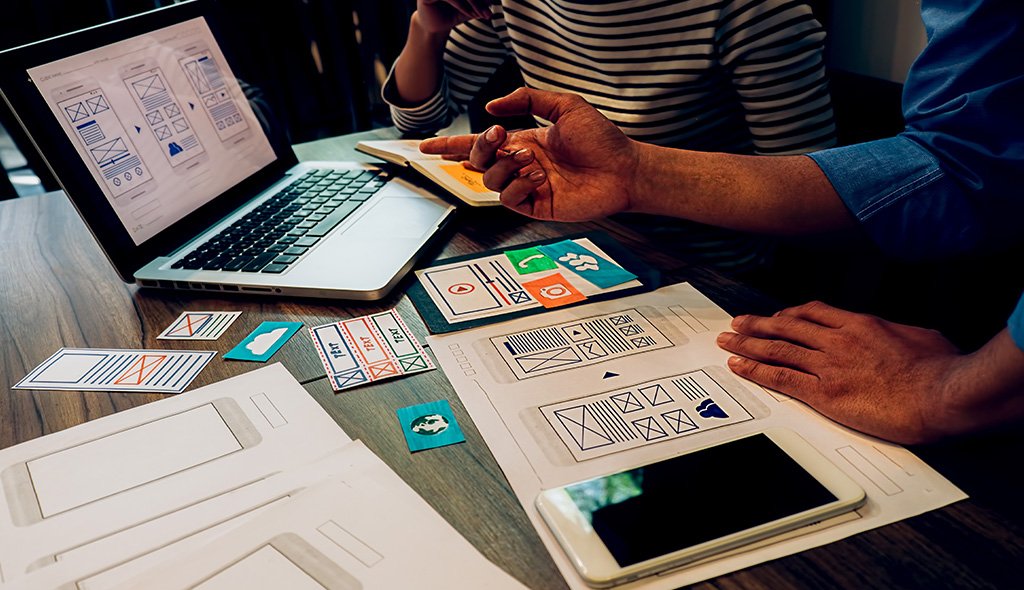
We translate mapped opportunities into low-fidelity wireframes and interaction concepts that explore multiple solutions before committing to a direction. This divergent thinking prevents premature convergence on the first idea. Stakeholder review and rapid user feedback narrow options to the strongest concepts, which then move forward for detailed design development.

Selected concepts undergo structured usability testing with representative users. We observe task completion, identify confusion points, and measure satisfaction against defined benchmarks. This phase ensures that design decisions are supported by behavioral evidence, not opinions. The output is a validated design direction with documented user feedback and prioritized refinements ready for production.

We finalize the experience design into detailed interaction specifications, annotated user flows, responsive behavior documentation, and design rationale notes. These specifications give engineering teams everything needed to build accurately without ambiguity. Our designers remain accessible during implementation to clarify intent, review builds, and approve fidelity before release.
Review outcomes from over 1,000 client partnerships where our research-driven UX practice solved real product and business challenges.
Effective UX design demands more than general usability principles. It requires understanding how users think and behave within specific industry contexts. Our team works with organizations from early-stage startups to global enterprises, bringing the same research discipline to a consumer health application as to an internal logistics platform. Scalability, regulatory sensitivity, and cross-platform consistency guide every engagement we deliver.
We have delivered experience design solutions across healthcare, fintech, ecommerce, real estate, education, logistics, media, and enterprise SaaS. This breadth means our designers recognize sector-specific usability risks and user expectations by default. When you hire UX designers with this cross-industry background, you gain access to validated research methods, proven flow patterns, and information architecture strategies that have already been tested and refined in live product environments.

In a market where many agencies offer UX as a checkbox within broader design services, our team has built a reputation for treating user experience as a standalone strategic discipline. The recognition we have earned reflects a commitment to research depth, validation rigor, and measurable impact that clients consistently cite as the reason they return.
Research Before Pixels: Every engagement begins with user evidence, not visual design. We validate problems before investing effort in solutions that may miss the mark.
Embedded Domain Specialists: Our UX designers are grouped by industry vertical, bringing healthcare, fintech, and enterprise fluency to engagements without requiring a learning period.
Outcome-Linked Engagement: We define success metrics at project start and track usability benchmarks throughout, so design impact is visible and reportable to leadership.
We use industry-standard research, design, and collaboration platforms to produce experience design work that integrates seamlessly with modern product development and engineering workflows.









UX Stalwarts understood startup urgency perfectly. Finding senior designer in 14 days who elevated product was transformative. Velocity rising 340% and retention 34 to 78% proved strategic impact.
UX Stalwarts solved our challenge perfectly. Mid-level placement in 10 days reduced costs $65K was transformative. Conversion up 23% and revenue $340K proved elegant solution.
UX Stalwarts found exceptional talent perfectly. Junior designer in 8 days at $65K delivered was transformative. Raising $3.2M and with design quality proved high-potential value.
Evaluating a UX design partner? Here are the answers that help decision-makers move forward with confidence.
Start by evaluating their research methodology from a ui ux design agency in india. A strong UI UX design company will demonstrate a clear process for understanding users before designing solutions. Review their case studies for evidence of user research, journey mapping, and usability testing rather than just polished visual screens. Ask how they measure design effectiveness after launch. Check whether their team includes dedicated UX researchers or if research is treated as an afterthought. Client retention rates are another strong indicator. Companies that deliver measurable UX improvements retain clients over multiple projects rather than relying on one-off engagements.
Costs depend on project scope, engagement duration, the seniority of designers assigned, and the depth of research required. Agencies typically offer fixed-project pricing, monthly retainers, or hourly models. For a focused usability audit, costs are modest. For a full-product experience redesign spanning research through specification, the investment is higher but reflects the strategic depth involved. When you hire UX designer India or hire ui/ux designer india through an agency, you access competitive rates backed by globally trained talent without compromising on research quality or delivery standards. Request a detailed scope breakdown before comparing quotes.
A UX designer focuses on how a product works and feels. They conduct user research, map journeys, define information architecture, and validate designs through testing. Their primary concern is whether users can accomplish their goals efficiently. A UI designer focuses on how a product looks. They handle visual elements like typography, color systems, spacing, and component styling. In practice, these roles overlap, but they require different skill sets. When you hire UI UX designers or hire UX UI designer profiles, you ideally get both disciplines working in coordination, which is a core strength of working with a full-service UX UI design agency.
Timeline varies by scope and complexity. A targeted usability audit or UX research sprint can take two to four weeks. A full-product experience design covering discovery, research, mapping, concept development, validation, and specification typically runs ten to twenty weeks. Factors that influence duration include the number of user segments requiring research, the complexity of user flows, stakeholder review cadence, and whether usability testing phases are included. We provide detailed timeline estimates during discovery, with milestone checkpoints that give you visibility into progress at every stage.
Yes. We offer flexible engagement structures including fixed-scope projects, sprint-based assignments, and short-term augmentation. If you need to hire dedicated UX UI designer talent for a three-week usability testing sprint or a focused information architecture review, we structure the engagement to match your timeline. Short-term projects follow the same research and validation rigor as longer engagements. The key is defining scope and deliverables clearly upfront so compressed timelines produce complete, actionable outcomes rather than surface-level recommendations. Many teams hire ui ux designers expert in short-cycle reviews.
Our teams have delivered experience design across healthcare, fintech, ecommerce, real estate, education, logistics, media, and enterprise SaaS. Each sector requires distinct UX considerations. Healthcare UX demands accessibility, patient safety, and regulatory compliance. Fintech UX requires trust calibration, data transparency, and complex workflow simplification. Ecommerce UX focuses on product discovery, conversion optimization, and checkout friction reduction. This industry depth means our designers bring domain-specific judgment to research, flow design, and usability testing rather than applying generic methods that miss sector-specific user expectations and constraints.
Getting started is simple. Share your project requirements through our contact form or schedule a consultation call. We review your brief, assess scope, and propose an engagement model that fits your timeline and budget. Once aligned, we begin the discovery phase with stakeholder interviews and documentation review. From there, our team progresses through research, mapping, concept development, validation, and specification. The entire workflow is transparent, with regular checkpoints, deliverable reviews, and collaborative sessions that keep your team involved and informed throughout each phase. Some clients hire ui/ux design consultant support during early scoping.
Accessibility is integrated into our UX process from the earliest research phase. We evaluate user flows against WCAG guidelines, test with assistive technologies, and design for keyboard navigation, screen reader compatibility, and appropriate contrast ratios. For regulated industries, we factor compliance requirements into information architecture and interaction design decisions rather than retrofitting them after visual design is complete. Our approach ensures that accessibility is a structural property of the product experience, not a surface-level audit applied before launch. Learn more about this in our guide on conducting a UX accessibility audit.
The difference typically lies in research depth and validation rigor. Affordable UX UI design services may cover heuristic evaluation, competitive analysis, and wireframing with limited user testing. Premium engagements include primary user research, multiple rounds of usability validation, detailed journey mapping, and post-launch measurement. Both can deliver genuine value depending on your product stage and budget. For early-stage products, a focused research sprint may be sufficient. For mature products with established user bases, deeper research and iterative validation justify the additional investment by reducing costly post-launch corrections. A professional UX UI designer guides this comparison.
We define success metrics at the start of every engagement, aligned to your business goals. Common measures include task completion rates, time-on-task, error rates, onboarding completion, support ticket volume, and Net Promoter Score. We establish baselines before design work begins and track movement after implementation. This approach ensures that UX impact is visible and reportable to leadership, not just felt qualitatively. You can explore our perspective on this topic in more depth through our blog on quantifying the ROI of UX design. Input from an expert UX UI designer sharpens measurement.
Absolutely. Our team includes designers experienced in responsive web applications, native iOS and Android products, and cross-platform experiences. When you hire UI UX designers for multi-platform work or hire UX UI designer talent, we assign specialists who understand platform-specific interaction patterns, gesture conventions, navigation models, and technical constraints. For products that span web and mobile, we create unified experience frameworks that maintain behavioral consistency while respecting the unique affordances of each platform. This prevents the fragmented user experiences that occur when web and mobile are designed in isolation.
Deliverables depend on engagement scope but typically include user research reports, persona frameworks, journey maps, information architecture diagrams, wireframes, interaction specifications, usability test reports, and annotated flow documentation. For engagements that include UX strategy, we also provide experience roadmaps and prioritization frameworks. Every artifact is designed to be actionable for your product and engineering teams, not decorative. We document design rationale alongside visual outputs so your team understands the reasoning behind each decision, which prevents context loss as the product evolves. A hire ui/ux design consultant arrangement fits this scope well.
When international companies hire ux designer india through an established agency, they access highly skilled UX researchers and experience designers at rates significantly lower than US or European markets. This cost advantage does not reduce quality. Indian UX agencies employ designers trained in global research methodologies, fluent in English, and experienced in remote collaboration across time zones. The time zone overlap with European and Asian markets supports real-time collaboration, while flexible working hours accommodate US-based teams. The result is expert UX UI designer services delivered with strong communication, cultural sensitivity, and meaningful cost efficiency.
A freelancer may work well for narrow, well-scoped tasks like a single user flow redesign. But UX work often requires multiple skill sets operating in coordination: researchers, interaction designers, information architects, and usability testers. An agency provides this integrated team with shared methodology, quality oversight, and project management. When you hire ui/ux designer india through an agency, you also gain continuity. If one designer is unavailable, the methodology and context remain intact. For complex products or ongoing engagements, an agency model delivers more consistent quality and broader capability than individual freelancers can sustain. Many teams also hire ui ux designers expert across niche tasks.
Start by reviewing their portfolio for evidence of research-driven work, not just visual polish. Ask for case studies that show how user research influenced design decisions and what measurable outcomes resulted. Evaluate their process transparency: a strong UX UI design agency or a credible ui ux design agency in india will explain their methodology, deliverable structure, and validation approach before the engagement begins. Request references from clients who have worked with them on comparable projects. Finally, consider a small pilot engagement to test communication quality, research thinking, and delivery reliability before committing to a larger contract. UX Stalwarts offers structured pilot engagements designed for exactly this purpose.

C – 81C, Sector – 8, Noida 201301, India


1025 Beamon Drive, Franklin 37064 Tennessee, USA
Sveavagen 34 111 34 Stockholm, Sweden
A-10, Sahastradhara Rd, Doon IT Park, Dehradun, Uttarakhand

© 2026 UX STALWARTS. All rights reserved.