Every paid click that doesn’t convert is a compounding loss: the cost of the click itself, the opportunity cost of a qualified prospect that leaves unconvinced, and a knock-on effect on campaign efficiency metrics that determine how much your next click costs. Landing page optimization services exist to break that cycle, not by redesigning pages arbitrarily, but by identifying the specific structural, copy, and trust signal failures that cause visitor intent to arrive at a page and then dissolve before action is taken.
As a specialist landing page design agency, UX Stalwarts brings information architecture, behavioural research, message match strategy, and systematic A/B testing to one integrated landing page practice. This means we don’t pass the design and research off to different teams who don’t often share insight: the same people who analyse your visitor behaviour design the page variants, write the test hypotheses, and interpret the results. There is continuity of thought across the design and research steps, which invariably performs better than fragmented, multi-vendor approaches.
Supported by eighteen years of UX design & digital product experience, our landing page conversion optimisation programmes cover the entire engagement lifecycle from technical performance audit and traffic source analysis through information architecture, copywriting, visual design, form optimisation, post-click experience design,n and iterative A/B testing. Every programme is not based on a generic page template that is applied regardless of campaign context, audience segment, and the conversion goal your digital marketing strategy requires.

Landing page conversion rate optimization starts with a discipline most page builders forget: the perfect match of ad headline, keyword, audience segment, and landing page copy into one neat, consistent message that confirms to each visitor, within the first three seconds, that they have reached exactly the page their click promised them.

Before any visual design is started, we create the structural sequence of every page the planned order of attention capture, value proposition delivery, evidence presentation, objection handling, and call-to-action placement because the architecture of a landing page dictates how well visitor intent will be channelled to conversion, regardless of how well-executed the visual layer is.

A paid search visitor with high purchase intent needs a structurally different page from a paid social visitor discovering a brand for the first time, and both are different again from someone clicking on an email where there is potential prior relationship context. We create pages for the particular awareness state of traffic and audience each campaign provides.

Form design is where conversion decisions are most frequently lost and most rarely optimised. We scope field count analysis, progressive disclosure design, multi-step form architecture, field sequencing, error message design, and submission micro-copy as distinct optimisation work because every unnecessary field or ambiguous label has a measurable abandonment cost that compounds across all campaign traffic.

No copy or design optimisation makes up for conversions that are lost on a page that takes 4 seconds to load on mobile, fails the Core Web Vitals criteria, or is poorly rendered on the device type that most campaign traffic uses. Every engagement starts with a technical performance audit to identify and fix these barriers before starting experimentation.

The conversion event is not the end of the visitor experience; it’s the place where expectations are highest and disappointed most often. We design the confirmation page, the thank you flow, and the lead acknowledgement flow as integrated parts of the landing page programme, because what follows the click is directly used to determine the quality of the lead, follow-through, and lifetime customer value.
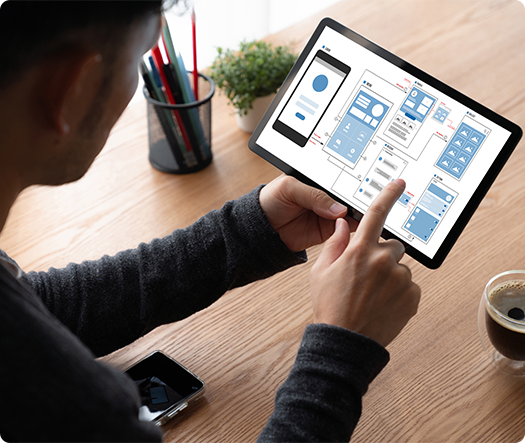
The most measurable return from a dedicated landing page programme is the revenue recovered from campaign traffic that was already qualified and arriving, each percentage point improvement to the conversion rate multiplied for every campaign running at the same time, reducing cost per acquisition without affecting media budgets. Working with a specialist landing page design company provides an additional advantage that performance dashboards lack: a gradually deepening understanding of what your audience really needs to see, hear, and believe before they will take action. UX Stalwarts brings that understanding through research methods that go beyond session recordings and heatmaps to the motivational and psychological layer of visitor decision-making insight that improves campaign messaging, creative strategy, and product positioning well beyond the immediate scope of any individual page.
Partner with experts who turn visitor data into high-converting experiences.
Our landing page optimization methodology treats research and design as inseparable disciplines; each phase generates evidence that directly shapes the decisions in the next.

We begin by doing an audit of existing landing pages against message match criteria, information architecture principles, trust-signal placement frameworks, and technical performance benchmarks, identifying the specific structural, copy, and loading speed failures we know are costing conversions before any redesign work begins. This is the phase of diagnosis that leads to a prioritised opportunity map, distinguishing quick-win fixes from issues needing controlled testing to responsibly resolve them.

Campaign traffic sources, audience segment definitions, keyword intent categories, and historical click to conversion data are analysed to establish what each visitor population already knows, believes, and needs to see before converting. This phase is to ensure that the page architecture, messaging hierarchy, and trust signal selection are calibrated to the (specific) awareness state and decision stage of the audience that is arriving.

Page structure is mapped before the design process: hierarchy of headlines, sequence of value proposition, sequence of benefit and evidence, objection handling placement, positioning of social proof, form design, and call to action. Architecture is determined at the wireframe stage. Conversion-focused copy is written in parallel, taking care that structural decisions and message decisions support both each other, rather than being reconciled after visual design is already well underway.

Approved wireframes and copy are converted to fully designed page treatments constructed for the specific campaign context, device distribution, and brand standards of each engagement. Development prioritises: Core Web Vitals compliance, Mobile rendering accuracy, form functionality, tracking implementation, and loading performance- because a visually excellent page that loads slowly or tracks inaccurately defeats the purpose of the entire programme.

A/B and multivariate tests are designed with pre-specified sample sizes and statistical significance thresholds, meaning that test duration and allocation of traffic will be determined before results are seen rather than after. This is the discipline that prevents the most common mistake in landing page testing, which is calling a winner when a positive signal is present in the data before the required sample size is met.

Concluded tests are analysed for conversion rate impact, secondary engagement metrics, and segment level variation, determining whether a winning treatment is consistent across all visitor types, or if there is a strong segment level treatment preference. Insights are recorded in a structured learning record that is used to inform the next cycle of tests so that each experiment is compounding rather than repeating the knowledge generated by the test before it.
Among landing page optimization companies trusted by 1,250+ global clients, UX Stalwarts documents outcomes in conversion lift, cost-per-acquisition reduction, and lead quality improvement. Explore the evidence.
A conversion rate optimization company in India that uses one page template that is the same for all campaign contexts will consistently underdeliver against one that knows the specific trust architecture and the length and type of decision journey and profile of objections in each sector it serves. The landing page requirements of a B2B Software as a Service product generating demo requests have a different structure to those of a direct-to-consumer eCommerce brand running discount promotions, and both have a different structure to that of a professional services firm building enquiry volume through paid search.
Our landing page optimization services have been provided for B2B technology and SaaS, eCommerce and direct to consumer retail, healthcare and wellness, financial services and insurance, education and EdTech, real estate and property technology, travel and hospitality, and professional services and lead generation businesses. Each engagement involves domain-specific knowledge of visitor trust thresholds, page length requirements, hierarchies of objections, and social proof formats that have the highest credibility among that sector’s buyer community.

Most landing page optimization agency engagements start with designing how to choose a layout, which template to go with, and what to write around it. As a research-led practice, UX Stalwarts starts with evidence: what is the specific visitor population already aware of, what are the objections they bring into the session, and what structural and copy decisions are most likely to resolve those objections prior to the call-to-action being encountered?
Alignment Before Aesthetics: Every page we build starts with the sharp alignment of ad message, audience expectation, and landing page content, not visual layout.
Structure Determines Performance: Information architecture decisions on what appears in what order and why are decided before any visual design work is done on a page.
Conversion Doesn’t End at the Click: The confirmation and thank-you experience is built into every landing page engagement, not as an afterthought.
We work with the industry's leading design, testing, behavioural analysis, and performance audit platforms to ensure every landing page decision is grounded in verified visitor data.









Vishal’s team transformed our lease application from a conversion killer into a revenue driver. The 42 percent improvement in conversion rate directly impacted our bottom line, and reducing completion time from eighteen to six minutes made the process actually enjoyable for customers.
TIS took our 2010-era warehouse management portal and completely transformed it into a modern, intuitive platform through deep user research and human-centered design. Customer satisfaction jumped from 42 to 87 percent, and our clients now view the portal as a competitive advantage rather than a necessary evil. The role-based dashboards and mobile responsiveness they designed have fundamentally changed how our customers interact with their inventory data.
TIS transformed our dashboard from a data dump into a decision-making tool. Executives can now identify critical trends in thirty seconds instead of spending hours compiling spreadsheets.
Evaluating a landing page partner and want direct answers before making a decision?
A structured landing page optimization service from the full programme lifecycle, from diagnostic audit to iterative testing. In practice, this means, expert review of existing pages from an architectural (message match) and information architecture stand point; analysis of campaign traffic sources and awareness states of the audience; page architecture and conversion-focused copywriting; visual design and development; A/B and multivariate testing with statistically specified sample sizes; form design and friction reduction; and post click experience design: the confirmation and thank you flow. Agencies that speak of landing page optimisation in terms of simply creating a new page and conducting one test are providing a fraction of what a complete programme involves and what it should provide.
Message match is the exact match of the copy, offer, and visual language of an ad and the corresponding headline, value proposition, and design of the landing page a visitor lands on after clicking on an ad. When this alignment is missing, when a visitor clicks on an ad that promises a particular benefit and is sent to a page on the website that opens with a different message, the cognitive discontinuity is registered as distrust or confusion, and bounce rates soar before the visitor even engages with any content at all. Strong message match is one of the highest leverage landing page optimisation decisions as it requires no traffic increase and no structural redesign: It recovers conversions that are currently being lost within the first three seconds of every session, across every campaign at once.
Website design deals with the entire architecture of a digital presence, navigation, content hierarchy, communication of a brand, and the range of user journeys a site needs to support. Landing page design solves for one, single, focused conversion objective in a specific campaign situation, for a specific audience coming from a specific traffic source. The disciplines share some principles but are differentiated in several important ways, as landing pages remove all navigation to remove the exit opportunity, subordinate all design decisions to a single call to action, and are only measured on conversion rate and cost-per-acquisition, not brand metrics or breadth of engagement. A generalist web design team and a specialist landing page design team take a fundamentally different approach to the same design brief with fundamentally different success criteria.
Broader CRO covers the full funnel, all types of pages, every step of the user journey, from awareness to purchase/ lead conversion through a programme of research, prioritised experimentation, and cumulative learning across the entire digital property. Landing Page Conversion Optimization. In particular, landing page optimization focuses on the post-click experience of paid and organic campaign traffic: that single page a visitor lands on after clicking on an ad, email, or search result that one specific conversion action is being sought. The scope is narrower, the traffic is typically more qualified and higher intent, and the optimisation levers message match, information architecture, form design, trust signal placement, and CTA clarity are specific to the campaign context in ways that broader funnel optimisation does not at the same resolution.
UX Stalwarts recommends five evaluation criteria for any landing page design engagement; First, ask how they go about message match. Do they start by analysing the ad creative, keyword, and audience segment before designing the page, or do they start with layout? Second, inquire about how they approach information architecture, whether page structure is determined at the wireframe stage, or if it is retrofitted around the visual design after the fact. Third, ask what their testing methodology looks like, specifically, how they determine the size of samples and the thresholds for significance before tests are begun. Fourth, ask if they scope the form design as separate optimisation work. Fifth, ask if they design the post-click experience as part of the engagement – the agencies that treat the confirmation page as an afterthought are not optimizing the full conversion event.
Yes. This distinction is one of the most consistently under-appreciated factors of landing page performance. A paid search visitor comes with specific keyword intent, a defined question that they expect the page to answer, and is typically in a higher consideration stage of the purchase journey. A paid social visitor often encountering the offer for the first time with no previous search intent, needs more narrative context before it is appropriate to ask for conversion, and is more responsive to trust signal placement and social proof formats. An email click-through visitor has some prior relationship context with the brand and requires less building of credibility but more clarity of the offer. Designing the same page architecture for all three types of traffic leads to constant suppression of performance for at least 2 out of the 3 channels.
A self-service landing page builder, however, is an appropriate tool when conversion performance is constrained not by strategic gaps in message match, information architecture, audience-specific design, or testing methodology but by a lack of a dedicated page. If you already have landing pages and they are underperforming – higher than expected bounce rates, low time on page, poor form completion rates, cost per acquisition is not improving with creative iteration – the constraint is rarely the build tool. It is this strategic and research layer that sits above the tool: what is the reason why the page is losing visitors, what are the structural or copy decisions that are causing this behaviour, and what exactly needs to change to fix that. That layer is something a landing page design agency can provide; a builder tool cannot.
Timeline depends on the volume of traffic, scope of programmes, and whether quick-win fixes are separated into controlled testing cycles. For pages with identified structural or message match failures – which are clear research-validated issues that do not require controlled testing to act on – meaningful improvement in conversion can be seen within two to four weeks of implementation. Controlled A/B tests need enough traffic to make the results statistically significant, meaning that a page getting fewer than one thousand qualifying visits per month may need six to eight weeks per A/B test to yield reliable results. Organisations running high-traffic paid campaigns often experience measurable conversion lift within four to six weeks of initial programme implementation, with compound improvement as the testing cycle builds up learning.
The most common and impactful conversion loss points (based on research across landing page optimisation programmes) are clustered around six areas: poor or mismatched headline copy that fails to deliver to visitors the confirmation that they are in the right place; value propositions that are below the fold requiring visitors to scroll before the page communicates why the offer is worth pursuing; forms that include more fields than are justified by the stage of conversion; trust signals that are too late in the page sequence to address the possibility of scepticism before the CTA is encountered; slow page load times resulting in qualified visitors abandoning a page before content has rendered; and calls to Each of these issues is identifiable through a structured audit before the design of any test or spending of any traffic.
UX Stalwarts brings landing page strategy, research, design, and optimisation at a level of engagement that reflects eighteen years of experience with UX and digital product work, not the cost-reduced quality reduction that some clients are used to getting from an India-based engagement. The commercial reality is that working with a specialist landing page design company in India delivers the same programme rigour, the same research methodology, the same architectural thinking, the same testing discipline at engagement economics that are forty to sixty per cent more competitive than equivalent practices in North America or Western Europe. For organisations with fixed optimisation budgets, this means more hours spent on research, more test cycles, more variant designs, and more comprehensive post-click experience work than what the same investment would facilitate domestically.
The answer relies on available traffic volume and not on the number of ideas in the test backlog. Running more concurrent tests than traffic allows within a reasonable statistical significance interval yields inconclusive results that waste the experimentation budget. A practical principle is to run the minimum number of variants to test a single, well-hypothesised structural or copy decision, usually two to three variants, and to resist the temptation to test multiple variables at the same time, on low-traffic pages where the sample you would need to detect meaningful differences between three or more variants would take months to accumulate. Prioritising test quality over test velocity, and sequencing down experiments by projected revenue impact, consistently yields more programme value than many parallel tests with underpowered experiment treatments.
Landing page conversion rate optimization has a direct and compounding effect on paid search Quality Score, Google’s assessment of the relevancy and usefulness of the landing page experience in relation to the ad and keyword that triggered it. Higher Quality Scores reduce cost per click, improve the ad position, and increase eligibility to participate in the auction without having to increase the bid levels. The specific landing page attributes that play a role in Quality Score are the match of page content and ad keywords (i.e., message match), page load time, mobile usability, and clarity and depth of content relevant to the search query. Optimising these things at the same time can improve both the organic conversion rate of arriving visitors and the media efficiency of campaigns driving them, as the compounding return is proportionately greater than the improvement in conversion rate alone suggests.
Landing page optimization companies run with several pricing strategies, each of which is appropriate for different engagement scopes. Project-based pricing involves a defined scope, usually an audit, a page redesign, and a set number of test cycles at a fixed cost agreed upon beforehand. Retainer-based pricing facilitates ongoing optimisation programmes with ongoing testing, learning documentation, and periodic page refresh as the context of campaigns changes. Performance-based models couple agency compensation to quantifiable improvement in conversion rates, but these arrangements require sound baseline tracking and well-defined, agreed-upon measurement methodology before engaging with an agency. The most fruitful engagements, in terms of programme value generated, often have a mix of an initial diagnostic and design phase at a project rate and an ongoing retainer with a velocity of testing and compounding learning over multiple test cycles.
Yes, but the two optimization objectives are based on different and sometimes competing principles of design, which makes the tension worth managing deliberately rather than ignoring. Paid traffic landing pages are generally clean of all navigation and purely focused on one conversion action, and are primarily tested on their click-to-conversion rate. Organic search landing pages must have adequate content depth for topical authority, natural integration of keywords and structural components, headings, internal links, and breadth of content to support search engine indexing and ranking. For pages that have to serve both objectives, the resolution is an architecture that retains conversion focus above the fold that provides enough depth of content in the body of the page to meet the requirements of organic search, a balance that requires deliberate information architecture decisions rather than retrofitting one objective onto a page designed exclusively for the other.
UX Stalwarts offer three post-programme engagement models to keep landing page optimisation going. A testing retainer is someone who keeps an active experimentation cycle going, testing on a monthly or quarterly basis as test rounds are run against a changing hypothesis backlog as campaign contexts, audience segments, and offer structures evolve. A campaign launch support model to offer on-demand page design and optimisation work that is aligned to new campaign launches, product releases, or seasonal promotions, where there is a need for new landing page architecture that needs to be implemented quickly. A periodic audit model examines landing page performance at specific intervals – usually quarterly – to identify conversion loss points introduced by product or campaign changes since the last engagement. All three models are wrapped up in learning documentation produced as part of the early programme, so that continuing work builds on existing understanding of visitors, rather than re-discovering what is already done.

C – 81C, Sector – 8, Noida 201301, India


1025 Beamon Drive, Franklin 37064 Tennessee, USA
Sveavagen 34 111 34 Stockholm, Sweden
A-10, Sahastradhara Rd, Doon IT Park, Dehradun, Uttarakhand

© 2026 UX STALWARTS. All rights reserved.